9.6.10

Ex Marks The Spot

I've just returned from not-so-sunny Devon - I'm assured the sun makes a big difference down in the South West - which is just as well, since I'll be spending part of this summer in the county working on a commission I was invited to take on a few weeks ago by Devon County Council and Double Elephant Print Workshop. It may have been damp and wet on my arrival for my first site visit in Exeter but I was warmly welcomed by the team at Double Elephant who showed me around the studio where I will be producing a series of screen-prints for the Politics in Print commission, inspired by the incredible collections at the Devon Record Office. I must say a huge thank you to both Katherine and John at the Record Office for their time and patience with someone like me who was in absolute awe of the James Bond-esque archive rooms (the ones where blocks of adjoining shelves move all in unison with a slight twist of a wheel... amazing!). I'll be working closely with them throughout my time in Exeter looking at political documents as early as 1590. A few highlights of the afternoon was seeing a letter by 1st Viscount Nelson in his own hand - of which he only had the one at that time - written only a few months before his death as well as political correspondence from Henry Addington who was Prime Minister in the early nineteenth-century. I will be documenting the commission at every stage before the run-up to the exhibition in September through my blog so be sure to come back for more updates.
Until then, here's a few encounters I came across during my stay... Double Elephant Print Studio is located in the town's creative centre, Exeter Phoenix - an Arts House with a nice vibe and a great gallery space. Currently on display are works by Anne Gathmann and Fiona MacDonald in A Point In The Field who both deal with themes of uncertainty and the ambiguity of our relation to reality in the natural world. Gathmann's works on paper act as architectural interventions, creating fragile spaces and invitations for exploration with works on the wall, floor and on simple sculptural forms. This simplicity complements the hyper-organic creations by MacDonald that resemble plant structures and microscopic organisms that washes across the canvas in cool colorways. I particularly liked her miniature sculptures that pay reference to the great tablueax of Goya and Titian with a dripping silicone quality that mirrored the fluid style of her two-dimensioanl works.
A Point In The Field installation - Fiona MacDonald
Aggregate, 2010 - Anna Gathmann
Yesterday I decided to head down Exmouth-way to the coast and with the sun trying very hard to make an appearance, I stumbled across A La Ronde on the outskirts of Exmouth. This National Trust property is one of the most peculiar and unique in its portfolio due to its sixteen-sided design. Completed in 1796, the house was the vision of Jane and Mary Parminter, wealthy spinster cousins who had the hexadecagon home built for them on their return from a ten-year Grand Tour of Europe. It is said it was the Basilica of San Vitale in Ravenna, Italy that inspired the cousins to build their twenty-room home looking down onto the bay in this fashion. The home's purpose however, was not solely a home, the interior is an example of carpentry and woodwork at its best with cupboards and seating that swing and slide open from internal walls and corridors.
The attention to detail has lead historians to think that regular builders of the era would not have had such expertise and therefore, it is said the Parminter cousins instructed local boatbuilders of Exmouth for their skill and craftsmanship to create the unique shape with space and functionality. When the sun finally decided to shine, it was obvious that the hexadecagon design made sense. All the rooms (apart from the fifty-four foot octagonal hall in the centre of the house) were adjoining, allowing the cousins to move from one sun-lit room to another throughout the day. If the exterior and internal structures were deemed extraordinary, then I could only imagine what visitors to the house of the time must have thought as I traveled from room to room following the sun. A La Ronde is a tribute to the Parminter's taste and sheer eclecticism for the exotic - every room is filled with objects and hand-made works that include bird feathers that decorate the cornices to minuscule paper cuttings and portrait silhouettes. But the decoration that must have been incredibly satisfying for these ladies of leisure has to be The Shell Gallery that sits at the top of the house. Created with nearly twenty-five thousand shells, pieces of mirror and feathers, the encrusted gallery was to represent the bottom of the ocean while the hall, draped in marine linen with painted walls was to resemble water to create a surreal topsy-turvey statement. The Parminter cousins were revolutionary to say the least and if you ever find yourself on Devon's coastline, be sure to experience a dose of eighteenth-century eclecticism for yourself.
Visit A La Ronde at Summer Lane, Exmouth, Devon EX8 5BD or click here for more information.

6.6.10

La Fin

This is the seventh and final post in conjunction with INTRODUCING's latest e-zine offering, Hypothetically. I'd like to thank everyone for visiting my blog and I hope you've enjoyed a different take on the themes from Issue X. A special thank you must go to guest editor Nicola McCartney for giving me the go ahead for this idea and allowing the blog to play a live and performative role in the issue... as well as possessing an unexpectedly strong French vein which I only just realise now and I hope I haven't deterred too many Anglophiles away! Please continue to view the works of Tory Smith, Gianni Notarianni, Jospeh Tovey-Frost, Ben Rogers, Catrina Stewart and Heather Bignell for Hypothetically.

For more information about any of the contributors visit INTRODUCING here and for all the new visitors from this week, I hope to see you again at jonathanvelardi.blogspot.com - next week I'll be reporting from delightful Devon. Until then mes amis...

5.6.10

Associated Press

Courgettes or Zucchini? Lambrini or Laurent-Perrier? Ryanair or Riva? These are a few questions I have been thinking about after speaking with Hypothetically's guest editor, Nicola McCartney, before the issue launched last month. Nicola introduced me to French sociologist and philosopher, Pierre Bourdieu and I have been captivated by his pioneering investigations and theories regarding the dynamics and power relations in social life. I have particularly taken to Bourdieu's primary research around ethnography - his first book, Sociologie de L'Algerie (1962) - since this was the basis of my own research at The Slade. It is his later explorations concerning the developments in everyday life however, that relate as mush to my ethos as to my artistic practice today. I have been known to loosely throw the term 'cultural caché' around with little understanding of its power that Bourdieu explains in his classic work, Distinction: A Social Critique of the Judgement of Taste (La Distinction) (1984) that looks at social structures and places them into symbolic orders. Although an academic, Bourdieu was perceived in France's public eye to be one of the people - an accessible intellectual - and a theorist that confronted the reality of social issues unashamedly. Through the processes of image recognition and association within varying demographics of society, the worth of his findings led to the definitions of a person's capital - being social, economic and cultural. Class and social positioning was determined by the attitudes and choices of the everyday that Bourdieu would simplify with the revelation of one's style of furniture and clothing; what one would eat on a regular day and a special day, the type of music that was favoured. All of these examples were strong factors that lay outside the realm of previous studies that based results around the educational system. With these everyday results, Bourdieu discovered society's naked taste: a taste that had been inherited from one's surroundings by natural association that was, if subconsciously, pure of any interventions from unnatural surroundings that one may come across during childhood - a theory he termed, habitus. For Bourdieu, this was a case that was much more than economic distinction between social classes. One's primary social field defined one's path through life by means of familiarity and natural choice. To change fields by entering a higher or lower social bracket was not theoretically comfortable, affirming Bourdieu's controversial stance that financial labelling was not a sole factor for social advancement when the symbols of everyday life play an equal part.

The image above is a good example of the type of visual recognition that plays a powerful role in our society, which advertisers profit from in abundance. Taken from a British newspaper between 2006-2007 in times of pre-recession and when British fashion house, Burberry were doing too well, becoming too accessible to the wrong type of social class, the lastminute.com "Get there before they do" campaign sells the idea that the wrong social class, a reference to the 'Chav' breed - borne from Labour's 'Cool Britannia' - were proving to be just as mobile as the middle and upper classes. The advertisement speaks to a more conservative class through the language of image association - an imitation Burberry check holdall - as a way of warning them to book their holiday sooner rather than later as well as opting for a more exotic destination that would not be on the they-in-question's geographical radar.
Brand backtrack: the Burberry check was invented in the 1920s
What is fascinating is that every aspect of society continues to follow the behaviours set out in La Distinction and without knowing it, the natural progression of society mirrors the cultural capital of individuals even in times when governments strive for change and social conflict persists. We only need to look back at the British General Election of last month and listen to the barrage of class distinction that was flung between the Labour and Conservative Party. I only had to log in to my Facebook account to gage the deep-rooted distain for private education (referring to Eton-alumni Prime Minister Cameron) that revolted many of my artistic colleagues. But aside from status-protest that clearly did not do them any good, the bourdieusian framework is everywhere. Whether we are drawn into the doors of Waitrose or Asda, paint our walls magnolia or arsenic green, go to art or medical school or even go to university at all, these are choices that although at the time may have felt foreign, were natural within our social field and continue to define our identity through social association.

I leave you with a story from my hometown, the Royal Borough of Windsor, Eton and Maidenhead. Taking association and bringing it to the political stage, was a recent campaign by the Royal Borough in the county of Berkshire, to dissassociate itself with the "SL" postcode - taken from neighbouring town Slough - famed by Poet Laureate, John Betjeman in his stanza, 
.
Come friendly bombs and fall on Slough! / It isn't fit for humans now... 
.
As he viewed the industrial town from the East Terrace at Royal residence, Windsor Castle in 1937. Unfortunately Slough's image has never recovered since and with ever-increasing petitions from residents in the Royal Borough to lose SL and replace it with "WM" (Windsor Maidenhead) for apparent reasons of economic and social amelioration, Bourdieu's theories are and will be forevermore du moment.

Visit INTRODUCING and jonathanvelardi.blogpspot.com  between 31st May - 6th June for more posts in conjunction with Hypothetically.

3.6.10

The Hermit Kingdom

No food. No electricity. No clean running water. No liberty. These may all be hypothetical statements in the Western world in the twenty-first century, but they are all too real in the Democratic People's Republic of Korea. 
This week BBC's Newsnight has had unprecedented-as-you-get-in-North-Korea access to capture what life is like in one of the most hypothetical society's on this planet. Sue Lloyd-Roberts, a BBC special affairs international correspondent, finds herself in one staged scenario after another as she is taken around what 'real' North Korean life is like under the dictatorship of the Great Leader Kim Jong-il. What is so fascinating in the two-part reportage is the discovery that Jong-il's late father, Kim ll-sung still holds the title of President and is believed will continue to do so for eternity. Flowers are offered in God-like fashion to both the late and current dictators, thanking them for a life that they genuinely believe is far fortunate than their neighbours in the South.


Lloyd-Roberts' British wit and journalistic tenure hold strong in the faces of the script-tied official minders. Her rare insight into a world where the saying 'if you don't know any better' rings loud across the Baekdu Mountain, explores the notion of belief through a system of rigid censorship. Although there are defectors that risk their lives to travel to South Korea, the generations that are left behind continue to live under the virtual grip of Communism that is slowing both economic and cultural development against the fast pace of modernity. What Llyod-Roberts found most alarming was the fact that the people who she encountered - some of whom forgot the script - genuinely believed that she and the rest of the West would believe the portrayal of a life that they only know how to believe in.


The next generation of delusional believers
View Sue Lloyd-Roberts and her special report inside North Korea at BBC Newsnight: Part 1 and Part 2

Visit INTRODUCING and jonathanvelardi.blogpspot.com again between 31st May - 6th June for more posts in conjunction with Hypothetically.

2.6.10

Desire In The Fast Lane

OK, so there's absolutely nothing 'hypothetical' about this but for one day only, the world of motor cars and modern art combine, finding themselves falling into each other's eyes in romantic Paris. The Centre Pompidou today is hosting the premiere of the 17th BMW Art Car - following in the footsteps of the likes of Lichtenstein and Warhol, Jeff Koons was aptly chosen for this year's commission to respond to a BMW M3 GT2 around the notion of desire.
I have to be honest and say a few months ago some CAD images were released of the proposed design and I had my doubts, but Koons has again surpassed himself, no pun intended, with bright and bold coloured lines that create a supersonic effect across the chassis with added in-your-face debris at the rear of the car to simulate power. Koons describes the notion of desire as '"life energy" - a power to achieve and create. Winning is everything on whatever life path you may be on. BMW is hoping to win with this power-hungry Art Car at this year's 24 Hour Le Mans race held on 12th-13th June 2010. Koons on the other hand is firmly on the winning highway of success and is not turning off anytime soon.
The 17th BMW Art Car may be viewed in the Forum of the Centre Pompidou today until 9pm with a book signing and talk with the artist at 6pm.

Visit INTRODUCING and jonathanvelardi.blogpspot.com again between 31st May - 6th June for more posts in conjunction with Hypothetically.

Stateside Of Klein

Ci-gît l’Espace (1960)
If you're stateside this year, be sure to check out the comprehensively rare retrospective of Yves Klein's work in America - a first in almost thirty years. In conjunction with the Hirshhorn Museum, Washington and the Walker Art Center, Minneapolis, the collection of two-hundred works will be exhibited thematically through the artist's infamous series of monochromes, fire paintings and sculptural reliefs. It will be a rare chance to see Ci-gît l’Espace (1960) and Ex-voto, dédié à Sainte-Rita (1961) in all of their gold-leaf glory. As with Hypothetically, the exhibition - curated by Kerry Walker and Phillipe Vergne - invite the viewer to see Klein as more than an object maker, but as a thinker and a philosopher: an artist in the contemporary world.
Ex-voto, dédié à Sainte-Rita (1961)
Yves Klein: The Void, Full Powers will be on display at the Hirshhorn Museum until 12th September 2010 and will travel to the Walker Art Center from 23rd October 2010 - 13th February 2011.

Visit INTRODUCING and jonathanvelardi.blogpspot.com again between 31st May - 6th June for more posts in conjunction with Hypothetically.

1.6.10

You've Been Krinked

Grafitti artist Craig "KR" Costello is leaving his mark this month at creative locale, The Base, in Taipei Taiwan. With his signature drip aesthetic created from his very own 'Krink' products, Taipei makes an appropriate location to engage in an unfamiliar arena even though the domination of communication and internet have made what were once distant cities, familiar surroundings. Using the urban landscape as his canvas, KR has krinked a Taiwanese Betel nut stand (below) and the facade of the Hotel Flowers Taipei (above) to complement his body of work at The Base - click here to check out KR in action with one of his trademark canvases. There's something about the drips that make me want to see a bigger picture through the myriad of the metropolis and follow the source of the drips - a journey that I think would not be so familiar at all.
KRINK runs at The Base, 台北市漢口街1段36號 B1 until 27th June 2010.

Visit INTRODUCING and jonathanvelardi.blogpspot.com again between 31st May - 6th June for more posts in conjunction with Hypothetically.

30.5.10

Hypothetically Speaking...

To all my regular readers things may be a little different this week but rest assured all will be explained - I must start however by welcoming all the new visitors from INTRODUCING and its current issue, Hypothetically. This week my blog will be dedicating posts around themes from the tenth issue that has been guest edited by artist and writer, Nicola McCartney. Born from INTRODUCING's curatorial duo, LIANGWEST and their first exhibition, The Blue Obelisk which I covered in April of this year, the issue's hypothetical themes of art, spirituality and culture are explored with a wonderful selection of contributors. This week I will be picking up on some of these themes while introducing some new ideas and directions with my own take on a hypothetical world.

McCartney's Editorial letter, Hypothetically Thinking, details her research on Yves Klein's 'The Chelsea Hotel Manifesto' of 1961 that accompany's her artwork, A Flock (After Klein) which also featured in The Blue Obelisk. Klein's determination to present art in its purest form lead to his own controversial development of colour that was used in a series of monochromatic paintings, sculptures and performances. The result was International Klein Blue (IKB) which is a patented colour in Klein's name and the colour for the blog throughout the week. Klein may possess the rights to colour, but he was also interested in the reaction his works created and their role as both physical objects as well as spiritual invitations for the viewer. The colour blue has great significance in several cultures and many religious beliefs due to its calming and stable connotations. The interview with artist and Roman Catholic Priest Father Gianni Notarianni provides an interesting insight between colour and space within the boundaries of a canvas. Father Notarianni explains the use of blue in relation to the iconic Virgin Mary in Catholicism and her blue robes that was a style brought about during the medieval and renaissance period. Having been brought up a Catholic, I remember as a child the colour blue being quite a feminine colour, seeing statues of the Virgin Mary draped in varying shades of welcoming and motherly-blue. But within the realm of hypotheses, religion is one of many beliefs or theories; conservative or radical, past and present that we invite into our minds to complement our daily lives. Whether it's a church or a favourite spot in the park or by the sea, as long as we allow ourselves the time to be hypothetical, belief in our own imagination is a powerful force in its purest form and I believe here lies the crux of one's creativity.
Our Lady Of Lourdes, Lourdes France
I would like to share a piece of music that will always remind me of my days at boarding school. Charles-Marie Widor's Toccata from his Organ Symphony No. 5 would be played at the end of our Sunday Service - with it's virtuosic passages, rapid runs and cascading fugals, it transports my mind as much today as it did then, to another world, where imaginations are free to run wild with the possibility of the impossible. I hope Mr. Klein would agree.

Visit INTRODUCING and jonathanvelardi.blogpspot.com again between 31st May - 6th June for more posts in conjunction with Hypothetically.

28.5.10

Like A Leica

Tom Sachs you are a Legend. In an era where your Facebook profile has to embody you, your life and your bank statement in a couple of thousand pixels, it's safe to say image is everything in the digital age. Sachs is notorious for taking iconic symbols from the world of names and brands - Hello Kitty, Chanel and Hermès to name a few - and manipulating them into equally recognisable symbols of the everyday such as urinals, chainsaws and guillotines. With the summer upon us and the potential of new profile pictures and albums that will be ripe for posting, Sachs has released the ultimate accessory to take those summer snaps with: Like a Leica (2010) is a hand customised 12 Canon SD780 IS Digital ELPH. The limited edition of twelve digital cameras available from Colette and directly through the artist, are in true Sachs-fashion; paint, marker and stickers cover any traces of the original Canon markings, the camera remains fully operational with a humorous detail of all it's functions listed where one would expect medium and dimension information and with a Tom Sachs signature on every box, what more could you ask for... a real Leica perhaps? Have a great weekend everyone!

26.5.10

New On La Rue

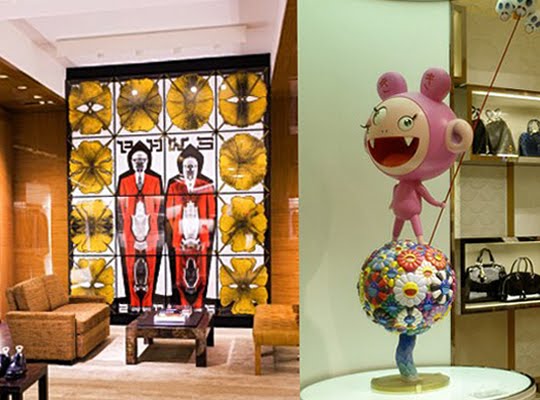
Defiance is seldom welcome, but resistance is never always futile and for Louis Vuitton's defiant expression on London's New Bond Street this week, capitalist cavaliers are shouting "vive la résistance!". Vuitton's Flagship store has had an estimated fifty-million pound face-lift and this undisclosed figure probably does not include several original and specially commissioned artworks that decorate the three floors of French luxury. 
The brand's 'Maison' status encompasses Vuitton's lifestyle vision and it comes as no surprise that the space on New Bond Street was chosen to define aspiration and luxury and celebrate a landmark date that coincides with the house's first store out of France - across la Manche in London - 125 years ago. Similar to the Flagship on the Champs-Élysées in Paris with it's top floor Espace Culturel exhibition space, London's Maison heavily focuses on the presence of contemporary art within the luxury market with selected works by both British and international artists such as Gilbert & George, Damien Hirst, Michael Landy, Jeff Koons, Anish Kapoor, Takashi Murakami, Richard Prince and Stephen Sprouse. Designed by famed New York architect Peter Marino, the Maison on New Bond Street will not only provide the most luxurious retail experience but a sophisticated education in culture that will rival their Bond street neighbours as well as their Mayfair gallery counterparts.

Visit the new Maison Louis Vuitton at 17-18 New Bond Street, London

21.5.10

Vodafone Ireland World of Difference

Founded in 2007, Vodafone Ireland has been supporting the charitable work of outstanding individuals through their World of Difference campaign. The programme offers four residents of the Republic of Ireland the chance to work with a charity of their choice for a year and for 2010 I am incredibly proud to support my very good friend, Karolina Sinéad Johansson who is a finalist to become one of the four chosen campaigners. Karolina has been working with the humanitarian aid charity, Chernobyl Children's Project international (CCPI) that offers sustainable community-based aid to deal with the multiple and long-term effects of the devastating nuclear disaster of 1986. With your vote, Karolina would be working to evaluate a De-institutionalisation Programme run by CCPI that will coincide with the commemoration of the 25th anniversary of the Chernobyl nuclear disaster in 2011. The programme will continue the work of CCPI's 'Homes of Hope' project that finds to re-home abandoned and orphaned children as well as providing a range of medical and social services that encourages the independence of young adults when they leave their orphanages and to keep existing family units together in what is a critical environment that is in desperate need for more global awareness.
As I'm sure you'll agree Karolina's campaign is more than deserving to be chosen for Vodafone Ireland World of Difference - this year votes are being cast through Facebook and I would encourage anyone to visit the site for more information about Vodafone's project and Karolina's inspiring campaign for the children of Chernobyl. Here's Karolina with her campaign mission in her own words and if you'd like to vote for her De-institutionalisation Programme for the Chernobyl Children's Project international click here.
GOOD LUCK KAROLINA!

19.5.10

Skyline Surprise

Chicago is famous for many things, but it's the city's skyline that is truly breathtaking. I was lucky enough to live in The Second City in 2005 while I was on an exchange programme at The School of the Art Institute of Chicago and I grew an affinity with the city that prides itself on it's town-like charm. Chi-town is a cultural capital and the Art Institute of Chicago houses one of the finest art collections in America, spanning more than five-thousand years of artistic expression from around the world. Connected to The School of the Art Institute, the museum made my walk to class more than average, but I'm wondering what current students make of British artist, Roger Hiorns and his commissioned work for the Modern Wing at the Institute. Untitled (Alliance) 2010, has been installed on the Bluhm Family Terrace, in which two Pratt & Whitney TF33 P9 engines lie in the foreground of Chicago's skyscrapers. Hiorns, who atomized an aircraft and filled a room with the dusty remains for the 2009 Turner Prize exhibition, uses commercial machines as symbols of power in society. The engines on display belonged to a Boeing EC 135 Looking Glass surveillance plane and Hiorn is interested in the value of such objects within a contemporary art context - further narratives are created by the artist's incorporation of three pharmaceuticals into the engines that are commonly used to treat trauma and depression, making a connection between global security and individual well being. No doubt visions of Pinal Airpark in Arizona and other infamous graveyards for planes that litter South West America will come to mind when confronted by these familiar, yet curious objects, but more controversial references of Homeland Security, planes and skyscrapers may be the most thought provoking work of art in an ever-changing and adaptable twenty-first century.
Untitled (Alliance) is on display at the Art Institute of Chicago until the 19th September 2010.

Express Yourself

I've been in Italy the last couple of days and made a swooping visit through Rome. The ancient city, and the whole of Italy for that matter, is blessed with the image created by its empirical ancestors and romanticised by Hollywood in the mid-twentieth century. The only trouble here is that I must be the only person who genuinely dislikes Rome and I'd even go as far as hate - and I rarely hate anything - but whenever I cast my critical ways on the city, I'm lambasted by people who claim their allegiance for pasta, espresso and sunglasses. I can understand your average tourist who's in and out of the city for a holiday, but I've lived in Rome and have known the supposed-dolce vita since birth and I ask myself every time I'm in the capitol, am I the only one who's seeing graffiti on every possible surface you could imagine? Not even to say it's good graffiti, in a Berlin-New York way - but for some juvenile's tag to be placed on ancient monuments and every street wall within and out of the city walls absolutely infuriates me. Italy in general has a very serious social problem that stems from political instability and depending on what region you're in, varying inflated egos.
While travelling northwards on the train into Stazione di Roma Termini, all the carriages were full of protestors heading to the city to march for educational rights. Protests are a common occurrence right across Italy, happening weekly if not daily in major cities and since they are rarely broadcast out of the country, Italy's stigma of social oppression is never seen when it's in the shadows of Roman Holiday or Gladiator. The government is not ignoring this problem for millions of Euros are spent on cleaning graffiti off important landmarks only for it to be re-tagged a few days later, so I was surprised to find on Termini's concourse a place for Italians to express themselves legally. It was fascinating to find the revolving advertising columns that usually feature Italian fashion campaigns, covered in a vinyl sheath: a blank canvas for revolutionaries and youth alike. I'm more than aware I will come across as scathing in this post, and I'm all for expression, but the problem is not the graffiti or the protesting, but the shear reason people feel the need to vandalise and march in the first place. Behind every social problem is a problem of the State that fails to see through the veil of power and I'm afraid to say Italy is one of the worst countries in Europe to suffer from this blindness. I encourage anyone to visit Rome - it's a city that is unlike any other in the world with a rich history and culture that is sold across the globe which you must see through your own eyes - I just hope the scrawls of anger are limited to columns of expression like the one above. And before you ask, yes some kid will tag the very top of the column and you'll know about it in big, bright, badly drawn letters.

12.5.10

SAM & Andy

Love, fear, pleasure, lust, pain, glamour and death may not be the first couple of words that come to mind when you think of Seattle. I know you're all asking yourselves, 'wouldn't Starbucks do?' but Seattle is not all about bad coffee - Seattle Art Museum (SAM) launches the exhibition, love fear pleasure lust pain glamour death, with a selection of Andy Warhol's media works. From film work to photography the show focuses on Warhol's fascination with all things ephemeral; fame, identity and desire, concluding he was a good thirty-years ahead of where our current society stands. Interestingly another exhibition in the adjoining galleries looks at grunge legend, Kurt Cobain, that resonates crudely of Warhol's vision with the short-lived reality of Cobain's celebrated life.
Both love fear pleasure lust pain glamour death and Kurt open today and run to the 6th September 2010 - for further information about the exhibitions at SAM click here.

11.5.10

Epic Summer

Continuing to push the the limits of marketing and the fine line between art and fashion, the House of Chanel launched it's Cruise Collection with a seventeen-minute - yes, seventeen-minute - film directed by Karl Lagerfeld, titled, Remember Now. Although not a new concept under Lagerfeld's creative direction, this epic short film exudes the unadulterated lifestyle that the Chanel brand predicts for 2011 and rejects any assumptions of recessional projections, glorifying Saint-Tropez as the centre of ultimate luxury. If you find glossy ads aren't doing it for you anymore, then this will give you your hit of aspirational ecstasy... that's if you can stand the not-so-epic acting. Expect more of these saturated flicks to filter down to the masses - finding it's way on a flat-screen on your local bus near you! Behold how the beautiful people live...

7.5.10

A Lot Of Possibilities #2: Update

Here a few installation shots from the exhibition, A Lot Of Possibilities #2 that took place a few weeks ago in New York. As I reported before the exhibit's opening, the work on display has been the result of incredibly hard work over the past year to integrate contemporary art within the context of a community garden in Manhattan. West 104th Street Community Garden was my main source of inspiration for my design, Flamingo Parade (2009-2010) - with the generous support from the Lower Manhattan Cultural Council and their relative departments, Flamingo Parade has been officially printed onto a gargantuan 31 x 9ft vinyl. While it hangs in splendor at WinterSpace, Anna Lise is working towards finding a suitable exterior wall in the neighbourhood for the vinyl to be installed and enjoyed by the Manhattan Valley community.
Many thanks to everyone for their attendance and support at the launch on the 24th April for all the projects on display. Come back for more photos and information from across the pond soon! If you'd like further information about the work or you'd like to make an appointment to visit Winterspace click here. Have a great weekend everyone!