Cameron Heads To Lanzarote Holiday On Ryanair http://t.co/y2Jpas8VqP
— Sky News (@SkyNews) April 13, 2014
Showing posts with label Politics. Show all posts
14.4.14
Come Fly With Me
18.11.13
Material Matters
I talk
with Lebanese artist Aya Haidar ahead of her upcoming exhibition, Year of Issue at Bischoff/Weiss and
stitch together the style, substance and success of her London-based
multidisciplinary practice.
. . . . . . . . . . . . . . . . . . . . . . . . . . . . . . . . . . . . . . . . . . . . . . . . . . .
Jonathan Velardi: It’s
unbelievably almost ten years since we first met at the Slade School of Fine
Art. I’d like to start with talking about an opportunity we both shared during
our time at the Slade. I can remember being very excited for you when you were
awarded a place at the School of the Art Institute of Chicago (SAIC) on
exchange in 2006. Having experienced SAIC for myself the year before, I knew
what an effect it was going to have on your practice, as it did mine at the
time. How important was your exchange to SAIC?
Aya
Haidar: Chicago was definitely a pivotal
moment in my early career. At the Slade I didn’t want to limit myself to
painting, media or sculpture. Most of my art has been about concept more than
medium, so when I went to SAIC the variety of media on offer was overwhelming.
I remember applying to do animation or something digital. These classes were
oversubscribed so it was actually a happy coincidence I found myself in the
Fiber and Material Studies department. I thought weaving and knitting were
simply practical pastimes - how could this be related to my art practice?
Within the department there were many different subjects that were so engaging:
one of them was ‘Propaganda and Decoration’. Just the sound of that title, in
that department, was amazing. They had huge weaving, sewing and screen printing
studios as well as the expertise behind it from so many tutors.
JV: Tutors whose
practice it was working with those very media - who were actively exhibiting
and working on projects and commissions.
AH: Completely. Because the tutors were practising
artists they were a resource as much as the facilities were. I wasn’t afraid to
try anything.
JV: You
explored your craft, quite literally, during your time in Chicago. Were you as
fearless with your concept?
AH: A lot of the subject matter I was exploring out
there was politically engaged. I was from the Middle East, making art about the
Middle East and the discourse from critique shaped my work critically,
conceptually and aesthetically. On my return to London from Chicago I was much
more confident as an artist as well as a thinker. The way I looked at art completely
changed for me.
JV: The art versus
craft debate remains contentious despite the feats achieved to date by the
likes of Turner prize-winning artist Grayson Perry. You’re a practising
contemporary artist based in London who continues to use the very media you
discovered at SAIC. What’s your opinion on the art versus craft debate?
AH: Craft is very much about the medium. Something
that falls under craft can be beautiful and utilitarian and it can stop at
that. Where craft ends and art begins is the manipulation of the material.
Fibre in itself is historically, socially and politically loaded. Where art
comes into it is when concept is introduced – the voice of the artist behind
the material.
JV: Things that are
perceived as craft speak louder to non-art audiences by way of familiarity.
Subsequently the handmade emits a greater accessibility than a
conceptually-bound artwork. I believe these are the core ingredients that make
your work so potent.
AH: The materials I use are especially loaded –
loaded from a feminist perspective but also from a very personal perspective.
My history was passed down to me through the medium of craft. Culturally, this
is such an important part of where I’m from. As you say, it is something that
is so familiar – everybody has a history with material: something personal to
them that their grandmother made or knitted. The industrialised world we live
in now was not like this several generations ago. The handmade is very
important in my practice. No matter where you are from, the material is where
we can go back to and it is something that is both familiar as well as having
the ability to hit people emotionally. When you see something that is sewn,
woven or knitted there lies an inherent narrative - even if there is a disturbing
or heavy message on it - you know someone’s hands made it and this human
element brings a contact between the artist, the artwork and the viewer.
JV: Both cultural and
personal narratives play important roles in your practice. How do you balance
being objective and subjective?
AH: I may be dealing with socio-political issues in
my region, but it’s not my intention to be political with my art - these are
universal issues that can be interpreted as social issues. My work is not about
statements but interpersonal revelations - stories that I have seen and
experienced; things I have been told. I’m creating an arena for discussion and
reflection by breaking down the stereotypes of the region that I am from and
revealing untold stories that are never reported on the news. For instance, I
look at regional conflicts across the Middle East – I never talk about Lebanon
versus Israel versus Syria versus Iran versus America. It’s more about the
stories of separation between mothers and children and the human cost of these
conflicts, which is so far removed from the cycle of global politics. These
subject matters are things that people can relate to: issues of displacement,
forced migration, human rights. These are things someone in Mexico or Zimbabwe
can understand just as much as someone in London. The way in which I
communicate all of this is through stitching, embroidery and weaving - that’s the language that was
translated to me where I’m from. Just as you are a writer and communicate
through words, I communicate with thread.
JV: Who passes on
these narratives to you and where do you source the ‘untold’ today?
AH: I’ve always been told where I’m from by my
grandmother and my parents. I’ve never lived in Lebanon but I’ve always
visited. I grew up in a Lebanese household here in London where these stories
were told to me. I completely consider myself Lebanese in the way that I was
raised and I am passionate about where I am from. Any artwork that I make about
the current situation across the Middle East is through my own personal
experiences and is not sourced virtually from my computer screen or my phone. I
am very active within a humanitarian context, whether it be helping refugees to
cross the border from Syria to Lebanon or working with Palestinian communities
in their camps.
JV: How are you able
to experience these scenarios first-hand?
AH: I don’t want people to think my experiences
fall under bourgeois tourism. My role as both Director of the charity, Al Madad Foundation as well as a contemporary artist feed into each other. The work I do
for the charity gives me exclusive access to the frontline of these areas and
enables me to be proactive with a mandate to make serious change.
JV: What is Al Madad
Foundation’s mission?
AH: Al Madad Foundation concentrates on long-term
development aid through education projects and sustainable emergency aid relief
that focuses on sanitation. Not many charities work on these aspects, mostly
dealing with provisions of food and shelter, which are very kamikaze in their
approach. The charity is trying to break this dependency within the refugee
community. In the last year we have worked directly in Syria - many
international organisations are not allowed to do this. Through our contacts on
the ground in Aleppo we set up a series of successful education projects and
schools for children that has returned order and discipline into the very
fabric of these communities that were once so broken. People forget Syria was a
middle-income country and that these refugees were educated teachers, lawyers
and doctors before the crisis. We look at their skills and hire them to teach
or rebuild their community for a wage in order to break this cycle of
dependency and to make sure their dignity and self-respect is preserved.
JV: Huge
congratulations with what you’re achieving with the charity.
AH: Thank you very much. We’re a small charity but
we do our part one person at a time, working towards long-term sustainable
change.
JV: We've witnessed the
marriage of aid and popular culture that was borne in the late
twentieth-century. Similar motions of awareness continue today and are almost
de rigueur amongst our contemporaries. How do you feel about ‘artists’ visiting
areas of conflict whose purpose can be seen as finite in their exposure of the
situation in these areas?
AH: This irritates me the most. For people to go
into these areas for their own selfish purpose is wrong - it’s not only artists
but politicians and self-styled activists too. I don’t see being an artist and
a humanitarian as separate things. I’m passionate about human affairs, politics
and injustices and I’m incredibly fortunate that I’m in the position where I
can bring concrete change on the ground. I’ve seen the human cost to conflict
with my own eyes. I’m told stories that have hit me emotionally and these are
echoed in my art.
JV: You’ve had huge art
success in the UK and across the Middle East. You were recently in Beirut with
the charity as well as for the launch of your first public art commission.
AH: That’s right. Refugee settlements are very much
a part of society in Lebanon. Dwelling
is made of corrugated iron from these settlements to create 18 birdhouses.
Ironically the piece is installed in Saifi Village, one of the most elite parts
of city. Each birdhouse plots the movement of refugees across the Middle East
and North Africa (MENA) region. The height of each birdhouse differs and
represents the number of refugees in that country from the tallest to the
lowest respectively. There’s no outline of a map, but it’s visually interesting
to see the waves of different heights.
JV: It sounds like a
real departure from the your other artworks.
AH: It’s the first time I’ve worked large scale in
metal – the opposite to the delicate works I’m known for. It’s been a great
opportunity to push boundaries on all levels.
JV: Dwelling couldn’t be more topical – when
massive displacement is taking place as a result of the Syrian conflict.
AH: The news talks about the hundreds of thousands
who are dead in Syria. What I’ve heard echoed by the refugees is that when
you’re dead, you’re at peace. It is the people alive who are suffering. There
are 4.25 million refugees displaced in Syria alone – this isn’t counting the
millions who have fled to neighbouring countries. The survivors continue to
suffer in these harrowing environments - they are cold, hungry and have lost
everything.
JV: Would you like to
do more public art commissions?
AH: I’ve really enjoyed working on this commission.
My practice is about engagement and taking it beyond the white walls of a
gallery space. I like the idea of art in everyday environments and being able
to communicate with a variety of audiences in their personal space.
Dwelling (detail), 2013
JV: Since your last exhibition at Bischoff/Weiss in 2011 we’ve had demonstrations span from the Arab Spring to the streets of Wall Street; The Protestor was crowned Time Magazine’s Person of the Year and the revolution of classified media driven by WikiLeaks continues to challenge the status quo. Propaganda, globalization and communication are all themes reflected in your practice. How important is it for you to revisit the past, in particular during times of present day crisis?
AH: A lot of the troubles happening now stem from
political relations in history. What I’ve noticed in the Middle East is that it
boils, it explodes and then it calms and repeats itself. Everything that is
happening now with Syrians in Lebanon is reminiscent to what happened with
Palestinians in Lebanon. It’s interesting you mention this notion of revisiting
the past because my upcoming exhibition Year
of Issue marries the past with the present. It’s about dating – everything
is chronologically archived. It looks at mandates and declarations of
independence, revealing how actually all of it is so pointless. My artworks
look at the significance of independence – are these countries any more
independent now than they were? No they’re not. Lebanon was made independent in
1943. Is it any more independent now than it was under the French? To answer
your question, this upcoming exhibition precisely looks at the past and brings
it to the present day and it will show how questionable history can be. In
relation to story telling, history is very important. I’m talking about the
human stories – these cannot be forgotten amongst trivial dates and policies.
JV: You’ve looked at QR
codes in your new body of work. I particularly like how you’re re-recording
these futile dates and policies by way of a process of permanence: the stitch.
The digital world has entered into fiercely political territory, as a powerful
tool for both the rebel and the institution alike. How have you introduced the
digital into your analogue practice?
AH: This is really interesting. For Year of Issue, I started with a very
specific concept and what grew out of it were the artworks. Even though the
exhibition is about chronology and history, the breakdown of language and
communication are equally important. One element of my practice is to breakdown
forms of communication and rework them. In this case, I have looked at QR codes
to reflect today’s generation of communicating. Instead of writing something
down we just scan for information. This has huge value because the Arab Spring
would have never sprung if it weren’t for social media. It provided a level
playing field – all the information was instantaneous and it didn’t matter if
you were up high or down low:
everyone had a voice. Technology however, also has it limits. Each QR
code represents the declaration of independence from each country. When I
embroidered the QR code what was interesting was that it became redundant and
didn’t work. The fibres create a hazy outline making it impossible for the
technology to scan it and therefore translate it. The stitch created a barrier
in communication preventing me to access the information. For me, it’s about the
strength of the old versus the new age of technology.
JV: When I saw these
works for the first time, I instantly saw a strong topographic quality to them.
Notions of espionage came to mind and I wondered how you felt about that.
AH: They do. For the integrity of the work, I know
that they’re created from the declarations of independence but no one will ever
know what is written because they won’t be able to scan them. I like that
there’s this power dynamic between you and me through the artworks. People feel
uncomfortable when they are kept out of the loop, or when they don’t understand
something. I felt this in my last exhibition in 2011 at Bischoff/Weiss, Behind Closed Doors, where I created an
environment out of closed doors that made people feel uncomfortable.
JV: I remember the
doors didn’t have any handles. You created not only a physical but also a
visual barricade.
AH: Exactly! It was interesting to see how people
reacted to the doors and how they interacted with them. Part of my practice
directly involves putting myself in uncomfortable or unfamiliar environments. I
remember for my first solo show, 1982
in 2009, the most important thing about that installation was the environment.
People entered the dark gallery with a high-pitched sound that inevitably
causes fear and anxiety. Following on with the doors, I significantly limited
access in the gallery space. Although the area was lit, people were forced to
walk through tight corners and around this wall of used doors that were closed
shut. I create a similar barrier with the QR codes – the works are about the
selectivity of communication in the same way media or propaganda is selective
in its content.
JV: But there is
communication within that even though it doesn’t follow through. Are you trying
to make the viewer work harder?
AH: My intention isn’t to hide any information.
With this latest work it’s about the document itself and how it’s communicated.
Whether you can read it or not, they are insignificant contracts. The
declarations of independence don’t make these countries any more independent.
You should ‘take’ your independence – no one should ‘give’ it you! With my
previous work, the way I communicate stories can be very direct through the
embroidery of text or imagery on shoes, blankets or story quilts. Other times
it’s not so direct and about the break down of language. There’s another piece
in Year of Issue where I’ve doctored
letters on envelopes that were circulated around the United Nations in the
Middle East. Language is fascinating. By just putting letters in different
sequences you can create so many different meanings and possibilities. By
taking away one letter or adding another and it can give a whole different
meaning to something. That’s scary and worrying. This is what I’m highlighting
in the artwork Return to Sender - it
talks about media and propaganda and how the manipulation of words can shape
peoples’ perceptions. Year of Issue
is really about language and communication whether it is visual, textual or
coded.
Covered Issues (detail), 2013
JV: How do you interpret the role
of an artist?
AH: I don't speak for all artists but in my opinion
the duty of an artist is to engage with people about their environments on
social and political levels. You may not be interested in what’s happening in
Syria or Lebanon but these are mothers, grandmothers and children that are like
you and me. What’s happening to them may very well happen to us. I believe it
is our social responsibility to work towards becoming a global community.
JV: For anyone who
hasn’t seen your art, I think it’s important to say that these political or
humanitarian issues do not burden the works. Aesthetically, they are seductive
in their execution and will speak to anyone through whatever degree of
contextualisation or superficiality they wish.
AH: Thank you. I hope these new works will
emotionally connect to many by way of their aesthetic and reveal the issues I’m
dealing with.
JV: Who influences you?
AH: I admire Mona Hatoum and Emily Jacir. Their
works are so topical, poetic and aesthetically beautiful.
JV: What’s the art
scene like in Lebanon?
AH: Lebanon’s art scene is predominantly
concentrated in Beirut. There are a lot of established Lebanese galleries who
represent some of the biggest names from the region on an international scale.
What’s more interesting is how the underground art scene is so alive. When you
walk around Beirut you see a lot of witty and political Banksy-style graffiti.
There’s also a lot of music, theatre and artist collectives made up of students
studying to be architects, doctors or scientists who are also engaging in the
arts. It’s an incredibly bottom-up movement, which is very important in a
country where there is so much pressure and tension. It gives everyone a voice
and it’s really amazing how creative and innovative people are. It also brings
communities together in a way like no other. I can’t help but be inspired when
I’m there.
JV: What area of Beirut
would you recommend for culture vultures?
AH: I like Hamra district for all the cafés, bars
and street art that is everywhere. I’d also recommend Agial Gallery run by
Saleh Barakat who has been in the business for decades and deals with modern
art. For contemporary art, The Running Horse and Sfeir-Semler Gallery in Khodr
district feature emerging talent from Lebanon and across the Middle East.
JV: #HIGHLIFE
AH: Gibran,
The Play is inspired by Lebanese literary great Khalil Gibran and his
seminal work The Prophet. The
production is currently touring the UK and the Middle East.
JV: #LOWLIFE
AH: Broadway Market in East London on a Saturday is
the place to go if you are a foodie.
JV: Thank you very much
Aya. It’s a wrap. Or it’s a stitch?
AH: It’s a knot!
. . . . . . . . . . . . . . . . . . . . . . . . . . . . . . . . . . . . . . . . . . . . . . . . . . .
Year of Issue by Aya Haidar - joined by
Huda Lutfi and Sara Rahbar - opens at Bischoff/Weiss, London on 21st November and runs to 20th December 2013.
14A Hay
Hill
London
W1J 8NZ
63 Abdul
Aziz Street
Hamra District
Beirut
Lebanon
Sleep
Comfort Depot Building GF
Shukri Al
Khoury Street
Khodr
District
Beirut
Lebanon
Tannous
Building
56 Al-Rehbane
Street
Khodr
District
Beirut
Lebanon
Gibran,
The Play
London
SW1Y 4HT
London
E8 4PH
Images courtesy of Aya Haidar and Bischoff/Weiss
Labels:
#highlife,
AL MADAD FOUNDATION,
Art,
AYA HAIDAR,
BEIRUT,
BISCHOFF WEISS,
BROADWAY MARKET,
CHICAGO,
CRAFT,
HISTORY,
KHALIL GIBRAN,
LEBANON,
LIFESTYLE,
London,
Politics,
SCHOOL OF THE ART INSTITUTE OF CHICAGO,
Travel
21.6.12
Dream On
Time Magazine's forthcoming U.S. edition explores the work-hard-play-hard ethos of a nation that has hit the top of the aspiration charts, but is it all singing and dancing in the world of politics, pop culture and picket fences? The Making of America Issue: The History of the American Dream hits newsstands this Friday.
3.2.12
Stereo-type
It has been a while since my last post and with the weight of guilt growing with every letter typed for my other projects I'm currently working on, I decided: it's Friday, the weekend is nearly here and I need distraction. So since there's nothing better than music and visuals to forget about work and the winter freeze that is engulfing the UK right now, I thought I'd share M.I.A.'s new music video that has been released today. Bad Girls, a track first featured on her 2010 Vicki Leekx mixtape, has all the M.I.A. trademarks, only this time around the scene is hot Middle East swagger with a booty of Nineties' references, all given the midas touch. Directed by Romain Gavras, desert grit-meets-bling along the oil pipeline that acts as bleachers onto the spectacle of old school BMW E36s and Alfa 156-boy racers, only it's not boys behind the wheel, but burqa-clad women. The opposite sex has played no small role in the Arab Spring across the Arab states - mounting pressures on Saudi Arabia, so far saved from uprising through internal repression, unfortunately have done little to overturn the driving ban for women and whether this a politically-charged message, "Live fast, die young / Bad girls do it well" or satirical stereotype in song, "My chain hits my chest / When I'm banging on the dashboard", M.I.A. is on the money turning the cars, chicks and guns formula upside down. I'll leave you to make up your mind about the burqa back up dancers...
Have a great weekend everyone!
14.12.11
HOPE Less
Whether it was TIME magazine's intentions to make a double entendre with their anticipated Person of the Year cover that was released today is unclear - The Protestor has been chosen to encompass the power of the people that has spread across the world from the passionate Arab Springs to the tumultuous riots in London and occupied streets in the Western world.
TIME commissioned Shepherd Fairey to illustrate The Protestor cover and it is a far cry from the artist's cover for the magazine's Person of the Year in 2008: Barack Obama - Why History Can't Wait. Fairey had used a version of his now iconic HOPE poster of President Obama that went viral during his American election campaign. The image evolved into something as synonymous with the word 'hope' - the very emotion in fact, the expectation of a better future; three years on, the world continues to be in a turbulent financial state and at least in America, Obama has not been able to work as much magic as he would have liked. The early jeers of 'No We Can't' sees the end of 2011 in a rather hope-less state.
For Fairey, he will be forever associated with the Obama campaign (A Casualty Of Politics? January 2010) however will perhaps want to disassociate himself with the President's recent publicity push in the run up to next year's re-election with his announcement of the end of the Iraq War today, in the same year that saw the death of Osama Bin Laden under his watch - all pieces in a "dumb" war effort which he was opposed to during his election campaign.
While the covers of The Protestor and Why History Can't Wait tell a poignant history of a changing world, TIME has chosen Fairey to define yet another movement: revolutionary times whose eyes no longer look up at the distance to the unknown, but now looks straight at you, for straight answers.
Labels:
#lowlife,
Art,
BARACK OBAMA,
Design,
HISTORY,
Politics,
SHEPARD FAIREY,
TIME
11.9.11
New York State Of Mind
Since the beginning of the month our eyes, our
ears and our hearts have been invited to turn to New York City in preparation
for the ten year anniversary of three numbers and a forward slash that can
arguably claim to be one of the greatest visual and audible icons of the twenty-first
century. The wealth of information that is stored on the web and press pages across
the globe – from the minute-to-minute eyewitness accounts, to the intimate
memories of those who were murdered, to the political data that form every
fact, as well as fuel any conspiracy - is as daunting to digest as the time
that has past since the world that I had known changed overnight on 11th September 2001.
As the saying goes, you will never forget
where you were and what you were doing. It was a Tuesday afternoon and I was
playing a game of inter-house rugby at secondary school when the first plane
hit WTC 1 – by the time I got back to my house the rumours that a small private
plane had crashed into a skyscraper were rectified by BBC’s breaking news
coverage in our TV room that would normally have been blaring out MTV – it was
quiet and the sight of both towers, hit by commercial jets and now burning like
gigantic candle sticks, was nothing but amazing. No Hollywood film could
recreate these scenes of reality that were so unfamiliar to our eye, this unimaginable,
this degree of perversion. As the evening wore on, I noticed the silence around
school and the silence in the sky – the westerly flight path to America from
Heathrow that passed over the campus was bare due to the hundreds of planes that had been grounded. What proceeded was to be a new way of life instilled with insecurity
and fear. I can still just about remember the days when smoking was allowed on planes; when I was able to pay a visit to the cockpit with my parents when we flew to America, the controls all lit up in technicolor and the pilot's view of the horizon so clear and bright. I remember sitting in the jump seat of a very full flight to London from Europe one summer - just the pilots and I - I will never forget that landing, a sight very few people witness or even have a peak at through the doors of the cockpit that are now sealed and protected – all moments in my early lifetime practically inconceivable today. I remember when security wherever you
are didn't use to take the extreme precautions that are now standard procedure;
when awareness towards another human being’s appearance and manner – and
religion - was less ruthless of stereotype, and if you are a dark skinned
Italian who had not shaved before going through airport security would not result
in a full pat down and even one time, an invite into a full body RapiScan (one of many products created for a post-9/11 world).
Reflecting Absence by Michael Arad at the 9/11 National Memorial
The attacks on the United States of America
were social and cultural attacks that have had global consequences affecting the everyday that has adopted a subconscious paranoia for generations past and where “war on terror”
slips off the tongue as easily as the daily death count of civilians and soldiers in the
war-torn Middle East witnessed by children of the new Millennium.
This weekend the people of New York will reminisce
beyond the landmark date, on what will be yet another year since their city was
violently attacked, while the rest of the world dissects the past decade from
the capturing and death of Saddam Hussein in 2003 and Osama Bin Laden this year;
questions will be asked about capitalism and religion and of the lessons that
have been learned by both the East and West, if any, through a plethora of
social media outlets that were not even around in 2001 – a sign of the times
that may have magnified a greater real-time hysteria that was so well
documented during this year’s horrific Japan tsunami.
What is certain is the fact New York will
not allow to be defined by the terrorism on 9/11, it’s heart far from broken, hurt
and still healing, but not broken.
Reflecting Absence by Michael Arad will be
officially inaugurated on 11th September at the the 9/11 Memorial at Ground Zero, Manhattan, New York
City.
In London, After 9/11 – an eight metre tall
sculpture fashioned from steel girders from the World Trade Centre wreckage - by
artist and New York native, Miya Ando has been installed in ‘The American
Ground’ of Battersea Park, Wandsworth, South London.
7.9.11
Behind Closed Doors
It is impossible to tune out of the developing events in Libya - the hunt for Muammar Gaddafi has cemented itself onto the news headlines for months and with the passing days and hours since the rebels advanced into Tripoli in late August, journalists and editors are already compiling the biography, or obituary, of the captured dictator when that day arrives. The Arab Spring has undoubtedly been the story of 2011. Waves of civil revolution along the Equator States have inspired the downfall of autocracy and government corruption in the name of positive change and the passionate demonstrations from everyone from exhausted nationals to citizens who returned to their native country to support the cause, has resulted in an incredible degree of social expression that has not been allowed an international stage until now. Expression plays a critical role in times like this - whether it be the formulation of a political manifesto that holds the burden of the ears of governments throughout the world, or the intimate act of elders passing their accounts on to future generations. Artists and curators from the Arab world are unsurprisingly gaining greater attention within international art markets for their genuine expression and reflection of the developing situation from their respective homelands. This year saw the debut of the MENASA Art Fair that showcased artists from the region gaining much international interest, particularly in Europe. It is hoped that the tired labels of 'ethnic' and 'exotic' are not driving this interest such as in African or Indian markets and the political weight that drives creativity is not merely a trend or short-term emerging market.
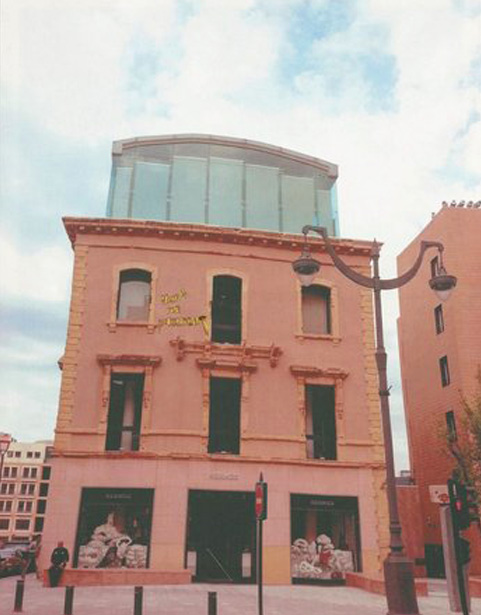
Yesterday night I proudly attended the opening of Behind Closed Doors at Bischoff/Weiss gallery to support my very good friend and fellow Slade alumnus, Aya Haidar. The mixed media exhibition incorporates a collection of photographic prints onto linen and an installation that relates to her practice of the process of handing down stories of Lebanon past and present, personal and political, which she encounters through family and friends on her visits to the Middle East. While Lebanon has served as a military playground for neighbouring powers, it's transparency and open society has saved itself from the absolute contempt felt by citizens in the Arab Spring. Once the Paris of the Middle East, the streets of Beirut are documented and manipulated by the artist - print IV from Recollections (Seamstress Series) embodies the meeting of the city's old world glamour and the reality of the everyday; depicting the French luxury boutique Hermès with an embroidered graffiti tag 'Haifa for President' above the boutique's entrance - referring to Haife Wehbe, a female pop star considered to be a sex symbol in Lebanon. The installation that can been seen from the street on Hay Hill, Mayfair invites the viewer to consider access and movement - actions that are taken for granted in everyday life; everyday life that benefits from the privileges of democracy. Unhinged was created for the exhibition and is a series of found doors connected together, their handles removed, to create a physical barricade within the space. Simulating the border restrictions and road blocks that are an everyday occurrence in the Arab world, the practical symbolism of a door is made redundant. What is so powerful about the work is the everyday-nature of a door - its very ease to erect is equal to its potential to be taken down.
Recollections (Seamstress Series) IV, 2011
As well as recycling materials to create installations, Haidar recycles the narratives that have been passed down to her and re-expresses them through her own voice and more literally, through her own hand with the intricate embroidery that is worked across the linen prints as a means of mending or perhaps preserving the well-travelled narrative that successfully engages with the political and historic within a contemporary context. I particularly like the term 'Seamstress' in the titles of the embroidered print collection - not only contesting the stereotype of craft within the art world. In the same way the artist has gathered stories from the market trader to the policeman, or from her very own Mother and Grandmother, they are all characters in the make up of society; all of whom have a story to tell. By therefore granting herself a role in this very make up, the 'Seamstress' playfully takes on both the intimate character who listens attentively while she sews and the powerful role as visual artist with something to say: opening doors one by one.
Recollections (Seamstress Series) XXI, 2011
Big congratulations to Aya for a brilliant show - for further information about the artist and her body of work visit Bischoff/Weiss.
Behind Closed Doors
7th September - 6th October 2011
Bischoff/Weiss
14a Hay Hill
London W17 8NZ
Images courtesy of Bischoff/Weiss
27.8.11
Just Deserts
While the daily front pages of newspapers after major world events try to encapsulate the night before, it is the cover of TIME Magazine that embodies the past, present and future all on one page. This week the web is crowning American illustrator Tim O'Brien as the 'go-to guy for fallen dictators'. Celebrated for his Osama Bin Laden TIME cover in May of this year, O'Brien creates another iconic portrait to what could be an end of an era for the Libyan dictator Muammar Gaddafi. Since the Libyan dictator is still on the run, O'Brien portrays Gaddafi in sand, his face only half blown away - no red Xs here quite yet - and although the TIME issue will not hit newsstands until 5th September, it also acts a metaphor for a country literally deserted by its migrant population and whose political and economic future is very much uncertain, rising out of an autocracy that lasted nearly half a century. What is certain is that the Libyan rebels hope Gaddafi will turn into a distant and forgotten mirage in the Eastern Sahara and this North African Spring can begin a new chapter in its history.
Visit Tim O'Brien's official website for more information about the cover and his own thoughts about the design process behind his work for TIME and other international periodicals.
Images courtesy of Tim O'Brien
5.6.10
Associated Press
Courgettes or Zucchini? Lambrini or Laurent-Perrier? Ryanair or Riva? These are a few questions I have been thinking about after speaking with Hypothetically's guest editor, Nicola McCartney, before the issue launched last month. Nicola introduced me to French sociologist and philosopher, Pierre Bourdieu and I have been captivated by his pioneering investigations and theories regarding the dynamics and power relations in social life. I have particularly taken to Bourdieu's primary research around ethnography - his first book, Sociologie de L'Algerie (1962) - since this was the basis of my own research at The Slade. It is his later explorations concerning the developments in everyday life however, that relate as mush to my ethos as to my artistic practice today. I have been known to loosely throw the term 'cultural caché' around with little understanding of its power that Bourdieu explains in his classic work, Distinction: A Social Critique of the Judgement of Taste (La Distinction) (1984) that looks at social structures and places them into symbolic orders. Although an academic, Bourdieu was perceived in France's public eye to be one of the people - an accessible intellectual - and a theorist that confronted the reality of social issues unashamedly. Through the processes of image recognition and association within varying demographics of society, the worth of his findings led to the definitions of a person's capital - being social, economic and cultural. Class and social positioning was determined by the attitudes and choices of the everyday that Bourdieu would simplify with the revelation of one's style of furniture and clothing; what one would eat on a regular day and a special day, the type of music that was favoured. All of these examples were strong factors that lay outside the realm of previous studies that based results around the educational system. With these everyday results, Bourdieu discovered society's naked taste: a taste that had been inherited from one's surroundings by natural association that was, if subconsciously, pure of any interventions from unnatural surroundings that one may come across during childhood - a theory he termed, habitus. For Bourdieu, this was a case that was much more than economic distinction between social classes. One's primary social field defined one's path through life by means of familiarity and natural choice. To change fields by entering a higher or lower social bracket was not theoretically comfortable, affirming Bourdieu's controversial stance that financial labelling was not a sole factor for social advancement when the symbols of everyday life play an equal part.

The image above is a good example of the type of visual recognition that plays a powerful role in our society, which advertisers profit from in abundance. Taken from a British newspaper between 2006-2007 in times of pre-recession and when British fashion house, Burberry were doing too well, becoming too accessible to the wrong type of social class, the lastminute.com "Get there before they do" campaign sells the idea that the wrong social class, a reference to the 'Chav' breed - borne from Labour's 'Cool Britannia' - were proving to be just as mobile as the middle and upper classes. The advertisement speaks to a more conservative class through the language of image association - an imitation Burberry check holdall - as a way of warning them to book their holiday sooner rather than later as well as opting for a more exotic destination that would not be on the they-in-question's geographical radar.
Brand backtrack: the Burberry check was invented in the 1920s
What is fascinating is that every aspect of society continues to follow the behaviours set out in La Distinction and without knowing it, the natural progression of society mirrors the cultural capital of individuals even in times when governments strive for change and social conflict persists. We only need to look back at the British General Election of last month and listen to the barrage of class distinction that was flung between the Labour and Conservative Party. I only had to log in to my Facebook account to gage the deep-rooted distain for private education (referring to Eton-alumni Prime Minister Cameron) that revolted many of my artistic colleagues. But aside from status-protest that clearly did not do them any good, the bourdieusian framework is everywhere. Whether we are drawn into the doors of Waitrose or Asda, paint our walls magnolia or arsenic green, go to art or medical school or even go to university at all, these are choices that although at the time may have felt foreign, were natural within our social field and continue to define our identity through social association.
I leave you with a story from my hometown, the Royal Borough of Windsor, Eton and Maidenhead. Taking association and bringing it to the political stage, was a recent campaign by the Royal Borough in the county of Berkshire, to dissassociate itself with the "SL" postcode - taken from neighbouring town Slough - famed by Poet Laureate, John Betjeman in his stanza,
.
Come friendly bombs and fall on Slough! / It isn't fit for humans now...
.
As he viewed the industrial town from the East Terrace at Royal residence, Windsor Castle in 1937. Unfortunately Slough's image has never recovered since and with ever-increasing petitions from residents in the Royal Borough to lose SL and replace it with "WM" (Windsor Maidenhead) for apparent reasons of economic and social amelioration, Bourdieu's theories are and will be forevermore du moment.
.
Come friendly bombs and fall on Slough! / It isn't fit for humans now...
.
As he viewed the industrial town from the East Terrace at Royal residence, Windsor Castle in 1937. Unfortunately Slough's image has never recovered since and with ever-increasing petitions from residents in the Royal Borough to lose SL and replace it with "WM" (Windsor Maidenhead) for apparent reasons of economic and social amelioration, Bourdieu's theories are and will be forevermore du moment.
Visit INTRODUCING and jonathanvelardi.blogpspot.com between 31st May - 6th June for more posts in conjunction with Hypothetically.
Subscribe to:
Posts (Atom)