Showing posts with label ROYALTY. Show all posts

10.1.14

Gifted

The end of 2013 marked the finale of what have been momentous occasions at the House of Windsor. Celebrations for Her Majesty The Queen’s Diamond Jubilee in 2012 and subsequent Coronation anniversary last year provided much pomp and circumstance, great and small, which touched all aspects and interests of the British Monarchy. Design, innovation, culture and sport all featured in the royal limelight and as is customary, gifts were duly presented to the Monarch from these various bodies that contribute to what must be one of the most eclectic collections in the world, spanning The Queen’s sixty-year reign.

 2012 Queen Elizabeth II Diamond Jubilee, 2012 - David Hockney
To celebrate the Diamond Jubilee, the Royal Academy of Arts, founded in London by George III in 1768, presented a gift to The Queen of over one hundred works on paper by practising Royal Academicians. The Diamond Jubilee portfolio followed tradition of two previous gifts presented to its royal patron – the first to mark the Coronation in 1953 and the second to celebrate the Silver Jubilee in 1977 – both of which had featured a host of prominent talent from the era.


Gifted: From the Royal Academy to The Queen, curated by Martin Clayton, Senior Curator of Prints and Drawings at the Royal Collection, presents the entire Diamond Jubilee portfolio featuring traditional and contemporary artists who have transferred their respective mixed media practices to art works on paper. Hung in the Salon-style at The Queen’s Gallery, the individual works from the portfolio encircle a painting by Johan Zoffany from the Royal Collection, The Academicians of the Royal Academy dated 1771-2. The painting is believed to have been commissioned by George III - as the Academy’s founding patron - and provides historical grounding of the long-standing relationship between fine art and Monarchy, as well as the developments of artistic expression through the centuries. Zoffany’s canvas depicts an all-male landscape of all the founding members in their finery setting up a life class with male nude models - training that was at the core of the curriculum, adopted from the French framework at the École nationale supérieure des Beaux-Arts in Paris. In contrast, the Diamond Jubilee portfolio portrays a very different representation of twenty-first century artistic practice in Britain; notably the inclusion of female members, the breadth of media such as collage (Joe Tilson) and photography (Michael Manser) to the latest technology with an iPad drawing courtesy of David Hockney, and not a life drawing sketch in sight. The exhibition is by no means a comprehensive representation of contemporary artistic practice, however high-profile names such as Hockney, Tracey Emin, Anish Kapoor, Cornelia Parker and Grayson Perry will cater to visitors who do not join the art crowd on its annual pilgrimage to the Royal Academy’s Summer Exhibition. 
Design for Kenilworth AMI, 2010 - Grayson Perry
Other highlights include the design for London 2012’s Olympic Aquatic Centre by international architect Zaha Hadid and a print by sculptor Phyllida Barlow in her trademark pink hues, who is preparing to take on the grand Duveen Galleries at Tate Britain this year in the name of the annual Tate Britain Commission launching in late March. 

While artists with controversial reputations in the art world are included in this exclusive portfolio, their restrained contributions may disappoint visitors expecting strokes of anarchy within the crimson gallery. On display are the beautifully crafted bespoke portfolio boxes that will archive the prints - reminding visitors that as with Zoffany’s painting, the works assume a new role, beyond the gallery walls, onto the royal timeline of history. 

Gifted: From the Royal Academy to The Queen runs to 16th March 2014 at The Queen’s Gallery at Buckingham Palace. Tickets include entry to Castiglione: Lost Genius - an exhibition of drawings and prints by one of the most accomplished draughtsmen from the seventeenth-century, Giovanni Castiglione. For further visitor information visit the Royal collection’s official website.

The Queen's Gallery
Buckingham Palace 
London
SW1A 1AA

Images courtesy of Royal Collection Trust
2012 Queen Elizabeth II Diamond Jubilee, 2012 - David Hockney
Inkjet Printed iPad Drawing on Paper, 20x14" © David Hockney
Design for Kenilworth AMI, 2010 - Grayson Perry
Royal Collection Trust / © Her Majesty Queen Elizabeth II 2013

27.7.13

Costume National

The annual Summer Opening of Buckingham Palace had an extra special plug before its official opening today - albeit indirectly - when Her Majesty The Queen disclosed to well wishers in Cumbria that she wished The Duke and Duchess of Cambridge’s imminent baby would arrive sooner rather than later as she was ‘going on holidays’. Prince George knew not to upset granny and arrived just in time to see her off before taking residence at Balmoral Castle in Scotland until the Autumn. When The Queen is away, the Royal Collection Trust opens the gates of the palace for visitors to explore inside one of London’s most famous landmarks and discover the wealth of fine art and objets d’art that make up this priceless, national collection. In what had been an extraordinary week for the House of Windsor in securing the line of succession for this century on the birth of His Royal Highness Prince George of Cambridge (Special Delivery: It's A Prince, July 2013), it was a pleasure to be invited to the scene of global interest on an unprecedented scale only a few days before, to attend the Press View of the palace’s State Apartments and exhibit before its public opening.
In 1953 London set the stage of pomp and pageantry that the world is so accustom with today. The Queen’s Coronation was the first major international event broadcast by the BBC on television and captured the atmosphere and regalia of a State occasion that remained essentially unchanged in British history for a thousand years. It made for potent viewing and set precedence for ceremonial documentation that too has changed very little with the planning of such events in the twenty-first century. The Summer Opening of Buckingham Palace celebrates the sixtieth anniversary of this historic event with the dedicated exhibition, The Queen’s Coronation 1953 that reunites art, fashion, jewellery and objects from the Coronation Day on 2nd June to recreate both the dazzling drama as well as the important sense of duty that had been bestowed on a young Princess Elizabeth.
Caroline de Guitat - Royal Collection Curator in The Ballroom
While many will have seen footage from the day countless times before, this year’s exhibit successfully complements the State Apartments as more than just rooms labelled for ‘official occasions’. Walking through the gilded interiors remastered by the architect John Nash under George IV, that very same footage comes to life as one stands in The Throne Room watching private scenes of a rather disorganised royal family trying to arrange themselves into frame for the photographer Cecil Beaton. One can only imagine the roar of cheers from the crowds that swamped the Mall, trapped in the palace's quadrangle that would have resonated from room to room as The Queen and her family prepared to celebrate over a State Banquet after returning from Westminster Abbey where the investiture took place. 

Visitors are welcomed into the exhibition space along the tour of the State Apartments by a marvellous contemporary visual installation in the Ball Supper Room of news footage - with the audio of a bygone reporting style in received pronunciation - in the run up to the Coronation, which is brilliantly displayed to project within the flat recesses of the ornate panelling and cornicing that decorate the walls of the room. A sculptural collection of wooden television sets from the Fifties show news items of families gripped with national pride, as well as the sheer excitement of television itself, with sets purchased for the very first time especially for the event. 

The black and white images that had been captured by Marconi MK II film cameras is in stark contrast to the glittering technicolour display, curated by Caroline de Guitat, of the royal and ceremonial costume, jewellery and personal items that are presented in the adjoining Ballroom. Here are a few highlights from my visit:
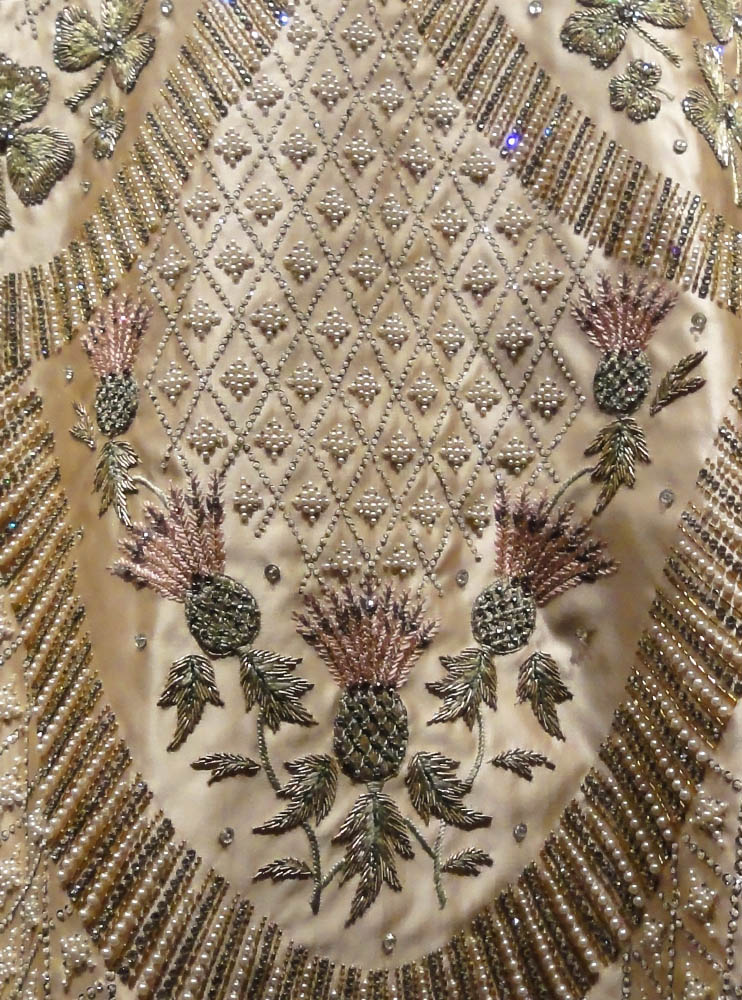
Encrusted floral symbols of the four countries of the United Kingdom 
Fashion enthusiasts will admire the beautiful iconographic designs by British couturier Norman Hartnall, who worked national and commonwealth floral emblems into the embroidery design of The Queen's white satin Coronation Dress - a breathtaking installation of minute detail on display for the very first time since 1953. The Robe of Estate - six and half metres of purple silk-velvet, lined with ermine - made my Ede and Ravenscroft, incorporates imagery of peace and prosperity in the form of raised wheat ears and olive branches along the edge of the train and frames the Monarch's new cipher, executed in fine gold thread by the Royal School of Needlework over four laborious months. Hartnall's sketches and test hoops from the school neighbour the completed garment in all its glory as the centrepiece in the exhibition space.
The Coronation Dress and Robe by Norman Hartnell and Ede and Ravenscroft
Putting on a show is nothing without diamonds and the iconic Diamond Diadem from 1820 by Rundell, Bridge and Rundell is paired with a necklace and earrings by R & S Garrard & Co. - masterpieces that are quite simply brilliant in name and vision.
Diamond Diadem, 1820 - Rundell, Bridge and Rundell
The Throne Chair and Anointing Dress
The Earl Marshal's Robe 
Preliminary works in watercolour on paper by the Polish-born British expressionist painter Feliks Topolski capture the energy of the spectacle, as well as the distinction between the young Queen and her fellow, more mature subjects adorned in their weighty attire. The Duke of Edinburgh commissioned Topolski to record the occasion in a large-scale canvas composition, Coronation Frieze, completed in the artist’s fluid style in 1960 that is on display at the very beginning of the tour. Illustrators will appreciate the charming invitation personally created for a young Prince Charles to attend the Coronation by Joan Hassall that reminds visitors of both the importance of provenance and preservation – ephemera is not a word in the Royal Collection’s lexicon.
In the Abbey - Coronation 1953 - Feliks Topolski
Coronets of Peers and Peeresses
The dress of the Royal Family including silk ensembles for Princess Anne and Prince Charles
The Ballroom and subsequent State Dining Room - exquisitely dressed as it would have been for the Coronation Banquet on Sèvres and silver-gilt service - display a rich chapter in British history and presents the beginnings of a global understanding of the symbolism of Monarchy in the twentieth-century. Curatorially loaded yet also restrained, given the vastness of the Royal Collection’s archives, the exhibition effectively balances the familiar with the impeccable detail of the new and unseen: a fine-tuned formula that will no doubt continue to contribute to the allure of such a unique spectacle that is a Coronation, guaranteed to be performed by the House of Windsor for future generations to come.

The Queen’s Coronation 1953 is part of a visit to the Summer Opening of the State Rooms at Buckingham Palace that includes access to the royal garden until 29th September 2013. The Royal Mews and The Queen’s Gallery also offer exhibits during this period – for further details about events, educational programmes and ticket information visit the Royal Collection's official website.

22.7.13

15.7.13

Special Delivery

The world’s Press have descended on London again to pitch up on very different turf from the sporting spectacle of twelve months ago. In a corner of West London, St Mary’s Hospital in Paddington has been home to international royal correspondents, news anchors and television crews for weeks, all eagerly awaiting the birth of Their Royal Highnesses The Duke and Duchess of Cambridge’s first child. Now days after media speculation the due date would be Saturday 13th July, newsrooms have surrendered to the waiting game, covering royal baby stories of both the absurd and sublime variety. 
From commemorative coins, chocolates and even cheese to a twenty-first century must-have: an app - affirming baby Cambridge as the most anticipated birth since the beginning of Twitter. The Royal Baby app, which intends to document various ‘firsts’ by the new addition to the House of Windsor in the coming months for dedicated royal followers who simply cannot wait for ‘commemorative’ publications to hit newsstands day-after-week-after-month. I myself could not resist getting involved in The Great Kate Wait and I had CNN’s Royal Correspondent Max Foster question Mario Testino whether he would be shooting the first official photograph of the royal trio, after spotting him at a charity function at Prince Charles's London residence, Clarence House last week - could Testino be keeping silencioso
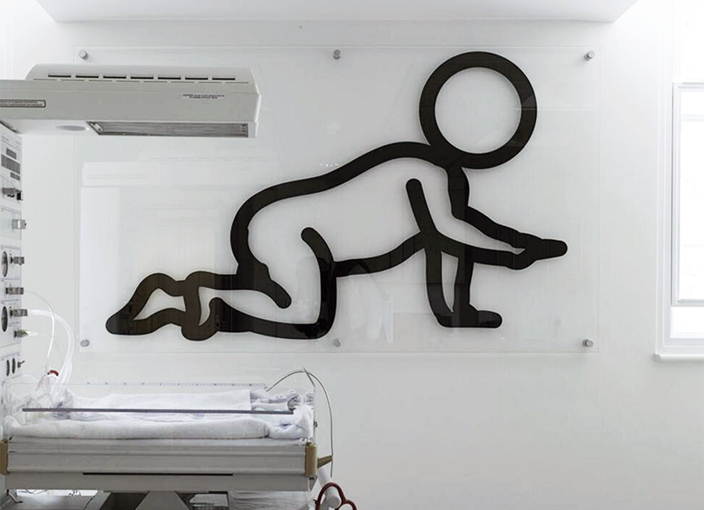
While the media scrum have created somewhat of an art installation in their own right out of stepladders and duct tape in a kaleidoscope of colours on the sidewalk opposite the hospital, within its very walls one will discover that even the art world is included in the royal baby furore. The sterilised operating spaces of a hospital are after all akin to the clean, white walls of a white cube and in the private maternity unit of the Lindo Wing - specialising in labour, delivery and postnatal care and where Princess Diana gave birth to Princes William and Harry in 1982 and 1984 respectively - the worlds of medicine and contemporary art come together in a unique installation created by British artist, Julian Opie 
During its eighteenth-month renovation St Mary’s Hospital commissioned Opie to create forty panels of his trademark graphic portraits rendered with minimal detail, using thick, black lines for both the interior and exterior of the Lindo Wing, where the Duchess of Cambridge is due to give birth to the third in line to the throne.
The permanent installation includes works of various sizes depicting tall, elegant women and crawling infants on transparent surfaces, light boxes and glass set against a neutral palette that feature along the walls of the wards, delivery rooms and building's façade. 
In an interview with The Telegraph, the artist talks of his intention to “enliven” patients with art that has a function to excite and the works certainly provide a special and alternative visual stimulus that is so very different from generic colour-conscious interior design, common on the bureaucratic agendas of public institutions. Given the Duchess is Patron of the capital's National Portrait Gallery she will appreciate the art around the unit and there is no doubt Opie will be amused that his work will be the first art seen by the future King or Queen of England. It would be wonderful if Their Royal Highnesses commissioned Opie to produce their newborn’s first official portrait in his contemporary style and save face amongst the art world with the rather disappointing choice of painter selected for the Duchess’s first official portrait unveiled earlier this year (A Portrait Of A Duchess, January 2013).
Paul, baby - 2001
My very best wishes to Their Royal Highnesses on their special delivery and as it so has been welcomed into this world, may their child be raised to reign supportive of arts, culture and creativity.

Visit Imperial College Healthcare NHS Trust for more information about the renovation to the Lindo Wing at St Mary’s Hospital. 

Images courtesy of Julian Opie

14.5.13

In Fine Style

For its latest exhibition the Royal Collection explores the sumptuous costume of British monarchs and their court during the sixteenth and seventeenth centuries. The Queen’s Gallery at Buckingham Palace has previously hosted celebrated exhibits such as Leonardo da Vinci: Anatomist and Renaissance works from Northern Europe – all of which are in no short supply in what is one of the finest, and oldest, comprehensive art collections in the world.
 
Henry VIII, c. 1530-35 - Joos van Cleve
With over sixty paintings, drawings, garments, armour, jewellery and accessories on display, In Fine Style: The Art of Tudor and Stuart Fashion documents the evolving avant-garde tastes of both royalty and the elite in England and across the Continent.

Speaking with me at a Bloggers’ Breakfast preview, the exhibition’s curator, Anna Reynolds explained the Royal Collection’s new agenda for The Queen’s Gallery as a cultural destination for all interests – akin to its London counterparts such as the Victoria & Albert Museum and Somerset House. Given the collection’s vastness of in-house content and context, traditional and academic themes have tended to be favoured over more popular avenues such as fashion, which incorrectly assumes superfluous and solely superficial status in comparison. What has been the culmination of three years of research In Fine Style is by no means art-lite. The exhibition is a first for the Royal Collection on several counts: it is the first time it has looked at fashion in portraiture; the first time objects have been loaned to the collection, breaking with longstanding curatorial mandate, and the very first time a playlist has been commissioned to accompany the exhibit. Anna proudly describes the collaborative, and eclectic, direction she has successfully achieved – working with The Blackborne Lace Collection at The Bowes Museum to XFM DJ and musician Eddy Temple-Morris and international fashion designer Gareth Pugh – to create a multi-sensory experience of fashion as spectacle as well as its depiction through art, bridging the historic with the contemporary.

As the first monarch to embrace fashion in court, Henry VIII welcomes visitors into the space by way of his potent portrait by Joos van Cleeve. Power was woven into the construct of fashion and there is no better royal than the second monarch from the Tudor dynasty to set the tone of the exhibition in all its rich, allegorical splendour. The meeting between Henry VIII and Francis I of France in 1520 in Balinghem, near Calais, was a dazzling installation by both royal courts to outshine one another using unimaginable quantities of elaborate gold cloth - woven with silk and gold thread - for costumes and the erection of temporary palaces. The monarchs had enforced so much attention to flamboyancy and presentation that the meeting place took the name, Field of the Cloth of Gold, due to is impressive execution and scale, to which this portrait is suggested to commemorate.
 
Young Royals power dressing: 
Princess Elizabeth I & Prince Edward VIattributed to William Scrots
This is a fine example of the roles fashion and taste played in communicating wealth and status – important aspects of Tudor life that can be traced down to Princess Elizabeth I and Prince Edward VI, painted by William Scrots, who flank their Father and join members of the Tudor court illustrated by Hans Holbein the Younger. Entry to the royal inner circle, which directly granted political and professional upward mobility, had been largely driven by personal appearance and the cut, cloth, colour and composition of garments and accessories became sartorial symbols of success for both sexes.
William Parr, c.1538-42 - Hans Holbein the Younger
Majestic monochrome: Henry Stewart & Charles Stewart, 1563 - Hans Esworth
In the knowledge that the exhibition has fashion in its title, it certainly triggers one’s attention to the cuffs, ruffs, pattern, pleating, jewels, hats and hairstyles that command equal weight with the historical significance of the canvas within this specific context like never before. In Fine Style questions the extent of the artists’ execution of representing fashion as the genuine article or an interpretation for canvas as not to detract from the subject. This idea of painting as a reliable source is raised in works by Sir Peter Lely who controlled his aesthetic by adapting the sitters’ attire. One of the exhibition’s highlights is a lace cloak band, or collar, reputed to have belonged to Charles I on loan from The Blackborne Lace Collection. The finely embroidered needle lace of linen thread is an exquisite example of technique as well as preservation of its rarity. Its allure is greatly magnified as it stands aside Sir Anthony van Dyck’s enduring triple portrait of the monarch, with only the glass display case separating its contents from canvas with an almost identical representation in form and design of the cloak band, depicted to be worn by the monarch in his profile to the right.
Charles I, before June 1636 - Sir Anthony van Dyck
A pair of late-seventeenth century embroidered velvet mules are looked on by their owner Henrietta Maria, wife of Charles I, in a nearby painting also by van Dyck. The dainty heeled shoes that were invented in France to project one’s social standing find themselves in an installation of extremes between the feminine and androgynous as can be seen in the portraits of cover girl for the exhibition, Frances Stuart, in dress and soldier costume – painted by Lely and Jacob Huysmans respectively. Simon Verelst’s portrait of Mary of Modena in a masculine-inspired riding habit also plays with notions of androgyny, the practicality of feminine attire and in this instance, a symbol of her marriage to the Duke of York who wore a similar coat design at their wedding in 1673.
 
Mary of Modena, c1675 - Simon Verelst
The low hanging installation of paintings is a triumph of intimacy between viewer and canvas. Fashion enthusiasts will no doubt be in their element when confronted with the intricate patterns of stitching or formation of pearls in oil paint and the minute brush strokes that form the illusion of crisp white ruffs that alone would have cost the equivalent of between £10,000 and £20,000 in today’s money.


The detail however can admittedly be overwhelming – even after five centuries, this is a testament to precisely what the royal court intended to achieve in its day. In addition to a video interview (above) with fashion designer Gareth Pugh who points to Elizabeth I as inspiration for many of his collections in his East London studio, the free multimedia guide also provides an excellent escape from up-close examination with a twelve-track playlist curated by XFM DJ Eddie Temple-Morris. 
In response to a selection of paintings that are featured in the exhibition, music by contemporary artists have been chosen to complement the works of art and introduce a unique visitor experience walking within the gilded setting that is The Queen’s Gallery. 
 
Charles II, 1644 - William Dobson
Some song titles easily link track to image – William Dobson’s painting of Charles II in armour is paired with Reso’s War Machine and van Dyck’s triple portrait of Charles I with Angles by dan le sac Vs Scroobius Pip. More abstract selections come in the form of Lana del Ray’s Blue Jeans hit remixed by Maribou State that reflects the ethereal score with the ethereal beauty of Frances Stuart. 
 
Frances Stuart, before 1662 - Sir Peter Lely
I particularly enjoyed Temple-Morris's choice of Dubstep in Nero's Innocence selected for the magnificent portrait of Charles I’s three eldest children by van Dyck. In 1635 the young Prince Charles  had come of age and therefore wears a golden doublet and breeches to display his loss of innocence, in contrast to the tradition of young boys, as depicted by his younger brother (centre) who wears a skirt. The 2010 release crescendos to a sense of foreboding that not only echoes the young Prince’s imminent future as King, but the state of the country during the English Civil War and subsequent execution of these children’s Father in 1649.
The Three Eldest children of Charles I, 1635-36 - Sir Anthony van Dyck
Armour’s design and styling on the battlefield directly copied fashionable tastes of the time, often with detail found on expensive fabric being replicated in metal through engraving and with additions to produce a highly decorative surface in silver and gilt. An extraordinary display links a miniature of Henry, Prince of Wales by Nicholas Hilliard at the age of thirteen wearing a suit of armour dating from early-seventeenth century France. 
Henry Prince of Wales, 1607 - Nicholas Hilliard
The same armour, or Cuirassier, that Hilliard illustrates can be found adjacent in all its intricate beauty and attention to detail that strikes an image of pure physical strength of the young prince.
 
Cuirassier armour, c. 1607 - French
In the final room of the exhibition, Continental tastes are explored as closer relationships are formed between the European courts. On the Continent, fashionable styles were closely linked to political power – Spain’s strong influence coincided with its political dominance across much of Europe in the sixteenth century that was later to be succeeded by France’s supremacy in both politics and fashion under the rule of Louis XIV from the court of Versailles. The English were viewed as chameleons, adopting different elements of costume from Europe as a result of greater circulation of prints and portraiture. It was not until Charles II's reign that a notion of Englishness, portrayed directly through fashion, developed in the eyes of Europe: introducing the precursor of the men’s three-piece suit and abandoning a short doublet and cloak for a long vest and coat – a trend the diarist Samuel Pepys could not resist to replicate. On display are portraits that demonstrate the links and distinctions across Europe that include mirror images of Prince Rudolf and his brother, Archduke Ernest of Austria wearing replica fashions painted by Spanish court artist, Alonso Sánchez Coello and the subtly divine costume of Agatha Bas by Rembrandt van Rijn.
 Rudolf II, Emperor of Austria, 1567 - Alonso Sánchez Coello
 Agatha Bas, 1641 - Rembrandt van Rijn
Fashion is one of very few facets in history that is able to communicate without words by means of a visual and tactile language. When discussing royal fashion, it is impossible not to mention the phenomena of style that has accumulated throughout the centuries to the present House of Windsor who receive fanatical dissection from head to toe. While technology may have opened up the once-exclusive royal wardrobe of material and styles, personal expression through fashion is just as powerful today as it was in Tudor England. From Victorian romanticism to a dapper Duke of Windsor; a colour-conscious Queen Elizabeth II followed by a furlong of hats and fascinators in her reign, to the most recent obsession with the fashionably accessible Duchess of Cambridge. In Fine Style presents an impressive formula for future curation:  in an age when modern monarchy is seen and not heard, it will be their costumes that historians will look to for invaluable messages of evolving identity to expose the social and cultural influences of epochs past, present and future.

In Fine Style: The Art of Tudor and Stuart Fashion is on exhibit at The Queen’s Gallery, Buckingham Palace until 6th October 2013.  For further details about events, educational programmes and ticket information visit the Royal Collection's official website.   
 
In conjunction with the exhibition, an interactive app has been inspired by a curious portrait miniature of Henrietta Maria that includes hand-painted overlays where she may be dressed in a variety of male and female costume. The free app allows enthusiasts to dress the rich and the powerful from the sixteenth and seventeenth centuries as well as take self-photos and transform into fashionable royalty of the day - available to download from iTunes.

Images courtesy of the Royal Collection © Queen Elizabeth II

13.1.13

A Portrait Of A Duchess

HRH The Duchess of Cambridge, 2013 - oil on canvas by Paul Emsley
It was the morning after the media furore as I walked up St Martin's Place to the scene of much debate and criticism. While the press pack had come and gone only the day before, my Twitter feed on Saturday morning continued to show virtual commentary on the Royal state of affairs that was the first official painted portrait of Her Royal Highness The Duchess of Cambridge“It’s just amazing…” said The Duchess to Paul Emsley, the award-winning Scottish painter who took brush to canvas for the Royal commission by the National Portrait Gallery, of which The Duchess is Patron.

With less than twenty-four hours since its official unveiling, it was a surprisingly quiet Saturday morning in Room 36 with only a handful of visitors standing face to face with the larger than life profile. Kate shares the space with the neo expressionist style of Paula Rego portraying Germaine Greer, the awkward repose of Thomas Adès by Phil Hale; John Keane’s bright strokes of Mo Mowlam and the requisite Royal military presence in neighbour, Lance Corporal Beharry from the Prince of Wales Regiment, in the illustrative style of Emma Wesley. The darkest canvas of them all, Emsley’s style of restrained oil application and glazing is in contrast to the liberal and fluid gestures that surround it. ‘The singularity and silence of form’ is how the artist describes his use of dark backgrounds – pair this with a limited colour palette of blues and greys, the result is certainly silent and perhaps misjudged for a young subject who only turned thirty this very week. Light, an element Emsley has gained recognition in capturing with his photorealist BP Portrait Award in 2007, has refracted into an unattractive haze that has unfortunately gifted her both unnecessary age and formality. Closing in on the canvas equally disappoints – no revelations are unearthed and the rather mottled skin tones that have had blue tones picked out from other areas in a hopeful attempt at depth, fall quite literally flat on The Duchess’s face. With only two sittings and a series of photographs taken by the artist himself, in a press release published by St James's Palace Emsley explains how Kate wished to be portrayed 'naturally' as opposed to her 'official self'. How then naturally translated into soft focus is a curiosity, however the amount of detail that has been dedicated to her hair and cascading locks – a feature that is globally scrutinized and which the artist surprisingly stresses its importance as being 'strong' and 'recognisable' in a trailer for the National Portrait Gallery (below) - has been executed with such staging and minute attention through a spectrum of grey and luminous copper hues; detail that has been starved from anywhere else across the visage. I found myself transfixed on the unusually defined right eyebrow that somehow escaped this soft focus – a distraction that would have been welcomed in the eyes that suffer from icy up lighting. And so to the mouth: does Emsley's notification that it turned from unsmiling to smiling contribute any more or less to my understanding? He only confirms Kate is in fact smiling, albeit enigmatically. In the words of my esteemed friend and artist Ana Cavic, is she the Mona Lisa?, a question that may be on the lips of art historians forevermore. 

It is however not entirely off with his head for Emsley. While he is the executioner, he is not alone for critical execution. It is reported that Kate was involved with choosing Emsley with the help of National Portrait Gallery Director, Sandy Nairne. Include the countless correspondence between palace and institution it would have been undoubtedly a daunting prospect for the new Royal. Yet given the strong signals that both Kate and her husband, Prince William have worked hard at expressing - that of a young, informal, changing face of the House of Windsor - the definitively conservative choice in artist and image is frustrating. The Sloane Ranger returneth is a message that instantly came to mind as I viewed the portrait, exposing another misjudgment on the part of Kate’s Royal advisors, or lack of if reports are to be believed. The Duchess’s choice of a navy blue pussybow blouse, made famous by former Prime Minister, Margaret Thatcher, teamed with heirloom earrings, present not only a potentially loaded composition but a stiff and detached icon of twenty-first century Britain through in an irrelevant Eighties filter. Also to be noted are the blouse’s sleeves that expose a possible amendment from their sleeveless state in the artist’s original photographs, which on canvas display very little effort to unify blouse with sleeve. If Austerity Duchess were the intentions du jour of Kate and company then this equally falls flat with delusion. Emsley and the club of traditional portrait artists command far greater amounts for this formal style of work than an emerging contemporary talent, which in my opinion would have been a far suitable choice - if not only for style, but also for substance. A graduate from London’s many fine art schools such as The Royal Academy or The Slade School of Fine Art, of which aspiring artists from around the world fight for student places, would have been a refreshing and powerful statement against the inevitability of Royal protocol. 

What hangs in Room 36 is a portrait engulfed in safety and unexpected dullness of one of the most photographed women in the world. It is a pity an artist, who may have delved into allegorical integration or played with personality through colour or set design, was not elected. As for the choice of frame – a very plain silver number – unsurprisingly has invited damning comparisons to portraits that may be found in establishments on the British high street: a first in the comparison archives for Royal portraiture to date. 

Emsley will now have to accept his portrait of The Duchess of Cambridge will eclipse his more celebrated works. For Kate, an alumnus of history of art, her first painted portrait now joins its very timeline and with Prince William, their duty as future King and Queen will consist of a whole life ahead of them with portraits and various immortalizations in the name of State and institution. In her early years as a new member of the Royal Family and a time that precedes the imminent birth of her first child, she may have wanted to be reminded of this special occasion in a different light in years to come: when she really is old and grey.


HRH The Duchess of Cambridge is on display at the National Portrait Gallery, London from 11th January to 1st September 2013 - click here for visitor information. 
Image courtesy of the National Portrait Gallery