Showing posts with label KATE MIDDLETON. Show all posts

22.7.13

15.7.13

Special Delivery

The world’s Press have descended on London again to pitch up on very different turf from the sporting spectacle of twelve months ago. In a corner of West London, St Mary’s Hospital in Paddington has been home to international royal correspondents, news anchors and television crews for weeks, all eagerly awaiting the birth of Their Royal Highnesses The Duke and Duchess of Cambridge’s first child. Now days after media speculation the due date would be Saturday 13th July, newsrooms have surrendered to the waiting game, covering royal baby stories of both the absurd and sublime variety. 
From commemorative coins, chocolates and even cheese to a twenty-first century must-have: an app - affirming baby Cambridge as the most anticipated birth since the beginning of Twitter. The Royal Baby app, which intends to document various ‘firsts’ by the new addition to the House of Windsor in the coming months for dedicated royal followers who simply cannot wait for ‘commemorative’ publications to hit newsstands day-after-week-after-month. I myself could not resist getting involved in The Great Kate Wait and I had CNN’s Royal Correspondent Max Foster question Mario Testino whether he would be shooting the first official photograph of the royal trio, after spotting him at a charity function at Prince Charles's London residence, Clarence House last week - could Testino be keeping silencioso
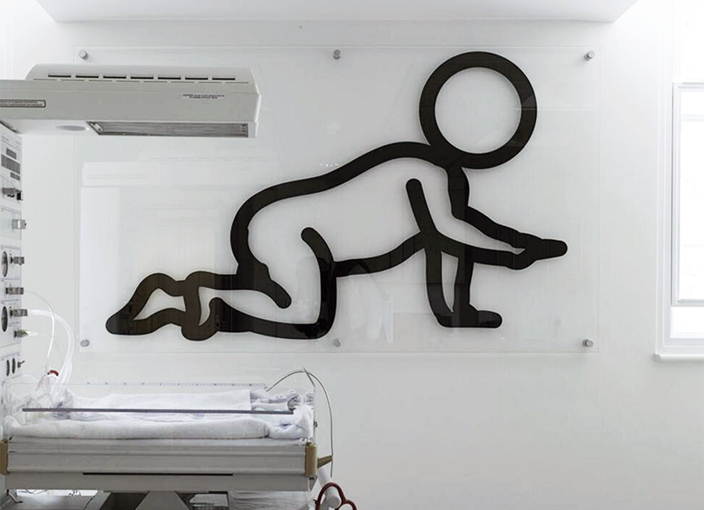
While the media scrum have created somewhat of an art installation in their own right out of stepladders and duct tape in a kaleidoscope of colours on the sidewalk opposite the hospital, within its very walls one will discover that even the art world is included in the royal baby furore. The sterilised operating spaces of a hospital are after all akin to the clean, white walls of a white cube and in the private maternity unit of the Lindo Wing - specialising in labour, delivery and postnatal care and where Princess Diana gave birth to Princes William and Harry in 1982 and 1984 respectively - the worlds of medicine and contemporary art come together in a unique installation created by British artist, Julian Opie 
During its eighteenth-month renovation St Mary’s Hospital commissioned Opie to create forty panels of his trademark graphic portraits rendered with minimal detail, using thick, black lines for both the interior and exterior of the Lindo Wing, where the Duchess of Cambridge is due to give birth to the third in line to the throne.
The permanent installation includes works of various sizes depicting tall, elegant women and crawling infants on transparent surfaces, light boxes and glass set against a neutral palette that feature along the walls of the wards, delivery rooms and building's façade. 
In an interview with The Telegraph, the artist talks of his intention to “enliven” patients with art that has a function to excite and the works certainly provide a special and alternative visual stimulus that is so very different from generic colour-conscious interior design, common on the bureaucratic agendas of public institutions. Given the Duchess is Patron of the capital's National Portrait Gallery she will appreciate the art around the unit and there is no doubt Opie will be amused that his work will be the first art seen by the future King or Queen of England. It would be wonderful if Their Royal Highnesses commissioned Opie to produce their newborn’s first official portrait in his contemporary style and save face amongst the art world with the rather disappointing choice of painter selected for the Duchess’s first official portrait unveiled earlier this year (A Portrait Of A Duchess, January 2013).
Paul, baby - 2001
My very best wishes to Their Royal Highnesses on their special delivery and as it so has been welcomed into this world, may their child be raised to reign supportive of arts, culture and creativity.

Visit Imperial College Healthcare NHS Trust for more information about the renovation to the Lindo Wing at St Mary’s Hospital. 

Images courtesy of Julian Opie

13.1.13

A Portrait Of A Duchess

HRH The Duchess of Cambridge, 2013 - oil on canvas by Paul Emsley
It was the morning after the media furore as I walked up St Martin's Place to the scene of much debate and criticism. While the press pack had come and gone only the day before, my Twitter feed on Saturday morning continued to show virtual commentary on the Royal state of affairs that was the first official painted portrait of Her Royal Highness The Duchess of Cambridge“It’s just amazing…” said The Duchess to Paul Emsley, the award-winning Scottish painter who took brush to canvas for the Royal commission by the National Portrait Gallery, of which The Duchess is Patron.

With less than twenty-four hours since its official unveiling, it was a surprisingly quiet Saturday morning in Room 36 with only a handful of visitors standing face to face with the larger than life profile. Kate shares the space with the neo expressionist style of Paula Rego portraying Germaine Greer, the awkward repose of Thomas Adès by Phil Hale; John Keane’s bright strokes of Mo Mowlam and the requisite Royal military presence in neighbour, Lance Corporal Beharry from the Prince of Wales Regiment, in the illustrative style of Emma Wesley. The darkest canvas of them all, Emsley’s style of restrained oil application and glazing is in contrast to the liberal and fluid gestures that surround it. ‘The singularity and silence of form’ is how the artist describes his use of dark backgrounds – pair this with a limited colour palette of blues and greys, the result is certainly silent and perhaps misjudged for a young subject who only turned thirty this very week. Light, an element Emsley has gained recognition in capturing with his photorealist BP Portrait Award in 2007, has refracted into an unattractive haze that has unfortunately gifted her both unnecessary age and formality. Closing in on the canvas equally disappoints – no revelations are unearthed and the rather mottled skin tones that have had blue tones picked out from other areas in a hopeful attempt at depth, fall quite literally flat on The Duchess’s face. With only two sittings and a series of photographs taken by the artist himself, in a press release published by St James's Palace Emsley explains how Kate wished to be portrayed 'naturally' as opposed to her 'official self'. How then naturally translated into soft focus is a curiosity, however the amount of detail that has been dedicated to her hair and cascading locks – a feature that is globally scrutinized and which the artist surprisingly stresses its importance as being 'strong' and 'recognisable' in a trailer for the National Portrait Gallery (below) - has been executed with such staging and minute attention through a spectrum of grey and luminous copper hues; detail that has been starved from anywhere else across the visage. I found myself transfixed on the unusually defined right eyebrow that somehow escaped this soft focus – a distraction that would have been welcomed in the eyes that suffer from icy up lighting. And so to the mouth: does Emsley's notification that it turned from unsmiling to smiling contribute any more or less to my understanding? He only confirms Kate is in fact smiling, albeit enigmatically. In the words of my esteemed friend and artist Ana Cavic, is she the Mona Lisa?, a question that may be on the lips of art historians forevermore. 

It is however not entirely off with his head for Emsley. While he is the executioner, he is not alone for critical execution. It is reported that Kate was involved with choosing Emsley with the help of National Portrait Gallery Director, Sandy Nairne. Include the countless correspondence between palace and institution it would have been undoubtedly a daunting prospect for the new Royal. Yet given the strong signals that both Kate and her husband, Prince William have worked hard at expressing - that of a young, informal, changing face of the House of Windsor - the definitively conservative choice in artist and image is frustrating. The Sloane Ranger returneth is a message that instantly came to mind as I viewed the portrait, exposing another misjudgment on the part of Kate’s Royal advisors, or lack of if reports are to be believed. The Duchess’s choice of a navy blue pussybow blouse, made famous by former Prime Minister, Margaret Thatcher, teamed with heirloom earrings, present not only a potentially loaded composition but a stiff and detached icon of twenty-first century Britain through in an irrelevant Eighties filter. Also to be noted are the blouse’s sleeves that expose a possible amendment from their sleeveless state in the artist’s original photographs, which on canvas display very little effort to unify blouse with sleeve. If Austerity Duchess were the intentions du jour of Kate and company then this equally falls flat with delusion. Emsley and the club of traditional portrait artists command far greater amounts for this formal style of work than an emerging contemporary talent, which in my opinion would have been a far suitable choice - if not only for style, but also for substance. A graduate from London’s many fine art schools such as The Royal Academy or The Slade School of Fine Art, of which aspiring artists from around the world fight for student places, would have been a refreshing and powerful statement against the inevitability of Royal protocol. 

What hangs in Room 36 is a portrait engulfed in safety and unexpected dullness of one of the most photographed women in the world. It is a pity an artist, who may have delved into allegorical integration or played with personality through colour or set design, was not elected. As for the choice of frame – a very plain silver number – unsurprisingly has invited damning comparisons to portraits that may be found in establishments on the British high street: a first in the comparison archives for Royal portraiture to date. 

Emsley will now have to accept his portrait of The Duchess of Cambridge will eclipse his more celebrated works. For Kate, an alumnus of history of art, her first painted portrait now joins its very timeline and with Prince William, their duty as future King and Queen will consist of a whole life ahead of them with portraits and various immortalizations in the name of State and institution. In her early years as a new member of the Royal Family and a time that precedes the imminent birth of her first child, she may have wanted to be reminded of this special occasion in a different light in years to come: when she really is old and grey.


HRH The Duchess of Cambridge is on display at the National Portrait Gallery, London from 11th January to 1st September 2013 - click here for visitor information. 
Image courtesy of the National Portrait Gallery 

25.3.12

Toile De Pomp & Pop Culture

The walls of Kensington Palace may have a wealth of stories to tell of its royal occupants since the seventeenth century; William III, the young Queen Victoria and Princess Margaret, however it is unquestionably recognized for its symbolic role adopted by the public as a place of tribute after the tragic death of Diana, The Princess of Wales in 1997. The sea of flowers and sentiments outside the late Princess’s home are some of the most iconic images of the twentieth century and has since shaped public behaviour towards celebrity and Monarchy alike.
Tomorrow the doors of Kensington Palace will reopen after a year-long twelve million pound restoration project in time for the Queen’s Diamond Jubilee and Olympic Games, launching with the exhibitionDiana: Glimpses Of A Modern Princess. Installed in Apartment 1A where the late Princess resided, and scheduled to be the future home of The Duke and Duchess of Cambridge next year, the exhibition will reflect some of the most important and memorable moments in Diana’s public life and will focus on her iconic fashion and style. If the Grace Kelly: Image Of A Movie Star at the Victoria and Albert Museum, London or The Metropolitan Museum of Art’s Alexander McQueen: Savage Beauty is anything to go by, fashion sells both on the streets as well as in the galleries and will undoubtedly be a sell out show for Historical Royal Palaces who run the royal residence in West London.
Dresses aside, the curators of the exhibition were intent to avoid a formal institutional display, perhaps conscious of the creative expectations that such showstoppers now command, and have commissioned contemporary illustrator Julie Verhoeven to produce a modern toile based on moments throughout the Princess’s life, incorporated into a wallpaper repeat pattern in a graphic collage in watercolour.
Diana with newborn Prince William
Drawing from photographs of Diana’s engagement announcement to Prince Charles, subsequent wedding, royal tours around the world and the last portraits to be shot by Mario Testino as well as architectural elements that resemble that of the palace or from Althorp, the resting place of the Princess at her ancestral home, Verhoeven employs her trademark technique to introduce a contemporary atmosphere within a loaded historical setting of both pomp and pop culture. While if a little naïve and childlike given the context of a woman in her prime, the style is resolutely Nineties, similar to the bright kitsch children’s wallpaper that I remember from the decade that was to be Diana’s last.
Diana shot by Mario Testino
Printed by hand in England by interiors firm and royal warrant holders Cole and Son who produce traditional period designs, the wallpaper will be installed throughout the exhibition in the palace’s State Rooms and will reflect the lasting influence in style and history of the Mother of the future King of England: whether this is the grande finale of a commercial chapter past in order to allow for chapters anew to evolve in the highs and lows of the dynasty of the Windsors is still to be seen. For now, memories of the past fuel what is a record period of public popularity and a right royal renaissance in the year where the matriarch of the British Monarchy celebrates sixty years on the throne.

Diana: Glimpses Of A Modern Princess
26th April - 31st August 2012
Kensington Palace
Kensington Gardens
London W8 4PX

16.11.11

Brand AD

I am very fortunate to call Windsor my home – twenty one miles from central London, the historic town in Royal Berkshire is famed by its castle and its royal residents throughout the centuries, of which the current Royal House adopted its namesake during a First World War rebrand – unsurprisingly Saxe-Coburg-Gotha didn't quite have the right ring to it. The town is pseudo-country; formed around the private and public crown estate of Windsor Great Park, one can instantly be lost in an ocean of forest or fields when exploring off the tourist ant-trail, only to discover there is much more history beyond the castle walls. Down the Long Walk - arguably the most impressive approach to a residence in the Land - and beyond the Copper Horse, lays a community of duty and heritage. While accessible only by foot or by bicycle to the public, The Great Park is my home turf and my runs around this five thousand acre estate over the years have still not taken me to its every corner. A few weekends ago I stepped back in time – the twelfth century to be precise – to visit the exhibition A Pageant of Heraldry organised by The College of Arms and Cumberland Lodge.
Cumberland Lodge is a residence within The Great Park dating from the middle of the seventeenth century. Since its formation as a charitable foundation in 1947, it provides an informal centre for academic exchange – it’s panelled rooms proved one of the most interesting exhibiting pop-up spaces I had been to for a while. 
During my time with the Royal Collection at Windsor Castle a few years ago, I could not resist growing a fascination with heraldry. Besides the fact that there is symbolism carved onto every chair, table, pane of glass and slab of stone around the castle apartments, as an artist the visual language that these symbols created were truly mystifying and formed one of the first concepts of a brand through visual recognition in history. Whether it is the sea of shields across the ceiling of St George’s Hall or the sacred decoration that is at the heart of the foundations of St George’s Chapel, it is easy to be enchanted by the genealogical history of characters past and present.
Heraldry derives from the word Herald and was first mentioned in Western Europe about the time of the First Crusade (c. 1100). Acting as messengers, diplomats and army staff officers, Heralds were attached to household rulers and magnates around the country where they used their expertise in identifying army commanders by their coat armour - markings painted on their banners and shields – since helmets denied facial recognition during war. This was a valued skill and precise identification in battle was paramount. Their experience led to taking responsibility of ceremonial duties at court and they were acknowledged as members of the Royal Household under Henry V in 1415 as ‘King of Arms’. 
Their device of indexes, rules and terminology around the insignia of arms form the basis of heraldic law and language that continues to provide a service today by the office of the Earl Marshal – itself a hereditary position through the Dukes of Norfolk since 1672 - who represent the Sovereign in the authorisation of all arms and grants. 
The exhibition illustrates the importance of heraldry as a mark of identification and charts the importance of heraldic seals as a means of authenticating documents in the late Middle Ages to the interest of institutions and public bodies from the beginning of the eighteenth century of which interest maintains in contemporary society and continues to be presented with an ornate Grant of Arms document approved with a Great Seal.
Tabard of King of Arms, bearing the Royal Arms on velvet
Tabard of Pursuivant of Arms, bearing the Royal Arms on silk
Highlights from the exhibit include tabards of King of Arms and Pursuivants of Arms beautifully embroidered on velvet and silk respectively, as well as The late Queen Mother’s personal banner which is uniquely on display.
While it is assumed that coats of arms are only reserved for royalty and nobility, with the emergence of a celebrity class towards the end of the last century within Britain’s inherent class system, a slice of noble decoration can in fact be purchased by anyone, at a price. With the trend ignited by rock royalty such as Sir Elton John and Sir Paul McCartney, celebrity culture in Britain aspired for heraldic heritage – this was notably documented in the press when David Beckham and then-to-be wife, Victoria Adams commissioned a coat of arms inspired by the British Premier League Football trophy in 1999. Reports came out that the couple wished for the swan - that is incorporated in the design - to face a specific direction and that it had been suggested the swan should face the opposite direction since the great heraldic lexicon dictated the original direction would have implied the male bearer’s sexual preference to men. Most recently however, the coat of arms of a certain Kate Middleton received global attention on the announcement of her engagement to Prince William. Royal protocol requires both parties of the royal couple to provide arms – the Middleton family commissioned a coat of arms with the help of Garter Principal King of Arms, Thomas Woodcock, resulting in a personal design that symbolised the family’s association with West Berkshire and their interest in outdoor pursuits, while representing all five members of the Middleton family through colour and composition.
Printed onto the official souvenir programme on the day of the Royal Wedding earlier this year (Something Old Something New, April 2011) it is undoubtedly the most recognisable coat of arms in 2011, if not this century. However once Kate Middleton officially married into the Royal family to assume her title of Catherine, Duchess of Cambridge, her coat of arms instantly ‘combined’ with that of Prince William. Where protocol necessitates this new design will be used to represent the Duchess and also gives the opportunity to watering holes around the country to fashion themselves after the newly appointed royal – the first pub in the country to be named after the Duchess was in fact registered in Windsor where the coat of arms can be seen above the entrance.

The importance of heritage in contemporary society is no more evident than in the new advertising campaign that was launched by British Airways in late September. While companies invest millions into rebranding their product with a new direction, the airline looked to their past and reintroduced a brand element from their 'Landor' livery that was used between 1984-1997. Perhaps a clever marketing strategy on the eve of the British Monarch’s Golden Jubilee as well as the hosting nation of the Olympic Games next year, the airline has chosen to reintroduce a newly stylised version of their coat of arms and motto, To Fly. To Serve - granted to them by the College of Arms in 1975 - on their aircraft, uniforms and all other aspects of brand BA. Profiting from the ‘made in Britain’ trend that is proving to be a currency worth investing in across all market sectors, the expression of genuine heritage is an element of branding money cannot buy. The majestic nature of a coat of arms supersedes any fancy, modernist design, embodying a sense of seniority, quality and even timelessness that will no doubt charm customers aboard the nation’s flag carrier.
A series of crests - including a chrysanthemum of the Emperor of Japan (centre) 
While contemporary events of public interest shine the media spotlight onto the heritage of the College of Arms today, it is the annual event of the Most Noble Order of the Garter within the walls of Windsor Castle at St George’s Chapel - heraldry’s spiritual home since the Order’s foundation in 1348 by Edward III – that emphasises the historical importance and splendour of a service that is so intrinsic in this country’s very own brand identity that will last for another eight hundred years.
A Pageant of Heraldry may still be viewed at Cumberland Lodge on Wednesday 26th November – click here for visitor information. For further details on heraldic history and lineage, enquiries may be made to the Officer in Waiting at the Collage of Arms, which is open on weekdays throughout the year. Access to St George’s Hall and St George’s Chapel at Windsor Castle is open daily – the wardens are well versed in the castle’s history and are more than happy to help with any questions – ticket information can be obtained at The Royal Collection.  

The College of Arms
Queen Victoria Street
London EC4
.
Cumberland Lodge
The Great Park
Windsor, Berkshire
SL4 2HP

28.4.11

Something Old Something New

With the eyes of the world transfixed on London with less than twenty-four hours away from the marriage of Prince William and Catherine Middleton, Royal Fever has firmly turned into Royal hysteria on the streets of the city and through the lenses of the teams of international media that is being broadcast around the globe. To commemorate the event, which is said to mark the beginning of a new generation for the British Monarchy, I have designed my very own something old into something new in tribute to the newlyweds. Inspired by British youth culture, Bigger Better has been exhibited in the luxurious environment of London's Selfridges to the urban elements of Sheffield, and has now been given the Royal touch with the names of 'William' and 'Catherine' entwined in Creole formation set in red, white and blue splendour of majestic purple.
To view a larger image of William Catherine visit my website here - for further enquiries about this work or information about previous examples of my practice please contact me at jmvelardi@yahoo.co.uk
All images are registered to the artist ⓒ JMVELARDI 2011
Follow tomorrow's Royal Wedding with the Official Programme that will be for sale from Explorer Scouts and Cadets in West London with profits benefitting The Foundation of Prince William and Prince Harry or is also available for download from officialwedding2011.org - enjoy the celebrations everyone and have a great long weekend!

19.4.11

Royal Fever

The weather isn't the only thing heating up this Spring in the United Kingdom - with record temperatures reaching 25°C, the country has also been gripped with fever in light of one of the most historic events in British history taking place in less than two weeks time. The Royal Wedding of Prince William with Catherine Middleton on the 29th April at Westminister Abbey, London will not only mark the betrothal of a future King but will also act as a benchmark of present and future styles of the twenty-first century.
With the internet awash with royal souvenirs and every other banner on your social networking sites and news pages reminding you to cash in from everything to coins, condoms and china, the high street is not missing out on any of the action and it is no more evident in my hometown of Windsor, Berkshire. Whether you're in need of Union Jack bunting and Long Live G&T cups (which I confess I had to purchase) for your street party or official merchandise from the Royal Collection at Windsor Castle, every avenue for profit has been tread and this is only the beginning. Having just returned from a weekend in Berlin, even German national news is taking a bite out of the wedding cake and newspapers and tabloids are making sure daily coverage in the run-up to the wedding has dedicated columns on their front pages. Advertising agencies have been working on numerous commissions for UK brands since the announcement of the engagement in November that have seen a series of launches in the last week - one of my favourites being for television network provider Freeview who feature the corgis who starred in The Kings Speech.

Freeview HD, 2011
While I still find it frustrating at many who do not understand the revenue the Royal Family bring from tourism across the globe to the British Isles, a wedding of one of the most famous Royal families in history is like setting another profitable arm in the already-desirable machine that is the Royal 'Firm'. While the press will endlessly compare the couple to times gone by, it will be the social significance of a young royal couple that will dictate future history as well as act as a font of inspiration and emphasis of royal association on all aspects of the everyday. In the same way the Prince and Princess of Wales epitomised the Eighties and beyond, the world has rarely experienced the same fever effect that next week's wedding will ignite. As art historians, Prince William and Catherine Middleton will know too well they have the ability to forge a global renaissance under the wings of the British Monarchy. 2011 has already seen an unprecedented series of Royal stories broadcast from the international press on various members of the Royal family bringing their diary of events and anyone associated with it into the forefront, very much in response to public demand. The launch of Facebook and Twitter accounts, an official Royal Wedding website and even a YouTube channel that will live stream the day's events reflects how the Press Office at Clarence House and the Royal Household respectively have embraced the digital age with gusto with minute-to-minute news and updates that have attracted nearly half a million followers across all social network faces.

The Royal Channel, YouTube 2011
So while it may be the end for the tacky memorabilia in less than ten days time, it is only the beginning of generations following the styles and tastes of one of the first royal couples to date to be immersed in the digital age and more importantly, be the first to play a part in how high royal fever rises - if they have anything to do with the recent weather we're having I think even the anarchists will be won over! News from my weekend in Berlin coming soon...