Showing posts with label SCULPTURE. Show all posts

30.9.14

Yayoi Kusama's Pumpkins

Between the towering cranes and construction that envelope the landscape of East London, a super-sizing of quite another sort may be found behind the walls of Victoria Miro’s Wharf Road gallery. In my latest blog entry for Ohh Deer, I visit a new body of work by visionary artist Yayoi Kusama. A series of three oversized pumpkins lie on the gallery’s enviable water garden – a fitting synergy with the Japanese artist’s longstanding intrigue of the natural world.
Pumpkins, 2014 by Yayoi Kusama - Victoria Miro, Wharf Road gallery London
Pumpkins mark the first time Kusama has worked with bronze on this scale, ranging from knee to head height. The plant has played a prolific role in the eccentric artist’s career – first making an appearance as early as 1948. After over five decades, Kusama affirms there is much more fantasy to be explored with this bulbous form, reinterpreted in her trademark Pop aesthetic that has been revered in major international exhibitions to commercial collaborations with luxury fashion house Louis Vuitton, under the direction of Marc Jacobs, as well as t-shirt graphics for Japanese retailer Uniqlo.

My full review Yayoi Kusama’s Pumpkins - on show until 19th December 2014 in the Victoria Miro garden - is now available to read on the Ohh Deer blog.

Look out for other public artworks by the artist during Frieze London 2014 at Frieze Sculpture Park in the English Garden in Regent’s Park between 15th - 19th October 2014. 

Follow @JMVELARDI for more on Arts, Culture & Lifestyle

Image courtesy of Victoria Miro

6.10.13

Musée Karl

Earlier this week the fashion industry descended on Paris for the capital’s annual Spring-Summer 2014 ready-to-wear shows. As with every season the hype around high-end labels whose heritage is rooted in the City of Light makes for high expectations. Luxury markets continue to defy a precarious economy; the fashion month across London, New York and Milan all positively contribute to the predictive economic barometer, however it is the finale in Paris, home of the highest concentration of the world’s leading luxury brands, where spectacle as well as style takes to the catwalk.
The House of Chanel is synonymous with the French capital and since his instruction as its Creative Director in 1983, so is the name Karl Lagerfeld. Chanel is one of the last iconic fashion houses to remain a privately held company and this privileged status has granted Lagerfeld carte blanche to envision and materialise both ready-to-wear and couture collections for over two decades. Every season Chanel resides within the ornate Beaux-Arts style of the Grand Palais, playing host to extravagant sets and theatrics that have earned Lagerfeld a following beyond front row fashionistas, to a greater audience in awe of both contextual breadth and sheer scale that is dedicated to only a fifteen minute show.
The art world is never too far from the fashion action. From Jeff Koons and Stella McCartney to last season’s Louis Vuitton collaboration with the Chapman Brothers (Game of CorpsesAugust 2013), the contemporary art meets luxury brand equation has proved to be a profitable currency of consumer culture. If designers had any intentions of art collaborations for 2014, Lagerfeld was ready to eclipse the competition with an impressive collection of 75 works of art, installed as a backdrop along the 340 metre catwalk. Ironically, the show overshadowed the departure of Marc Jacobs at Louis Vuitton the following day – arguably a pioneer of the art-luxury formula who successfully worked with a host of artists including Takashi Murakami, Richard Prince and Stephen Sprouse to name only a few, during his sixteen-year tenure at the French luxury house.

In the year of the Venice Biennale and with London’s Frieze Art Fair opening later this month, the Grand Palais was restored to its former self as the centre of art and culture through Largerfeld’s contemporary lens. Transforming the space into an art gallery to accommodate his evocative mixed media collection: each and everyone conceived by the designer himself,
“I made everything. I designed it and made small models… it’s not different young artists it’s only one old artist. It’s me”.
Karl Lagerfeld amongst his 75 artworks
Chanel has long been the source for artistic inspiration – the house’s enduring Chanel No 5 scent was screen-printed by Andy Warhol; Tom Sachs transforms its recognisable monochrome branding into killing machines – and it’s no surprise that the designer was inspired to create a collection for his customers to ‘go to an art opening’. 


Art’s infiltration in popular culture through collaboration and accessible limited edition production has created an editorial niche in fashion and lifestyle PR. Damien Hirst is a fine example - a brand in himself with several retail outposts under the name Other Criteria (Money MakerApril 2012). Hirst like many of his contemporaries actively collaborate with the worlds of mass market to bring the art on the walls to the silk around one’s neck to even the dinner plates in one’s home (Fine DiningApril 2013).
On fashion designers Largerfeld explains,
“In the past designers wanted to be socially accepted. That’s not modern anymore because nobody cares about that anymore… now they want to be part of the artwork… but the artwork doesn’t want to be taken for fashion… it’s ridiculous because art is always something with zeitgeist… the only one who understood it was Andy Warhol, who really got the right idea that those things can live together”.
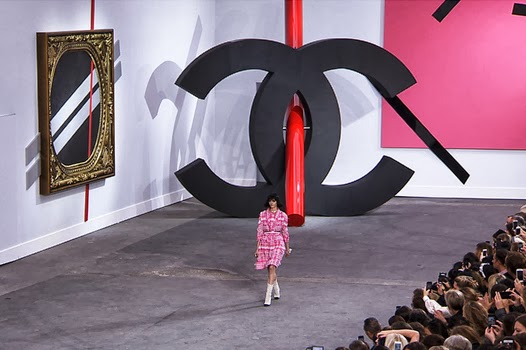
Lagerfeld’s ambitious installation precisely brought art and fashion together in a brazen pastiche of nearly every art medium imaginable. Eric Wilson from the New York Times tweeted the caption ‘The Metropolitan Museum of Chanel’ when confronted with the designer’s homages to Duchamp, Kadinsky, Lavier, Pollock, Oldenburg, Koons, Twombly and Jones. The visual codes of Chanel - camellias, quilting, chains, pearls, boucle and interlocking Cs – were rendered in a mélange of Pop art humour with conceptual execution around themes of sex, politics, power and wealth that would sit comfortably in the Gagosians and White Cubes of this world in what is an art-hungry marketplace. 
The monumental set fed the equally insatiable Instagramers and social media camps who documented a colourful quartet of industrial towers, leather-chained pylons and ladders; graphic canvases emblazoned with the distinctive house typeface; a glossy quilted sumo; an oversized, upturned 2.55 model handbag hung on the wall and a relic of a Chanel No 5 bottle in marble were sculpted in the inanimate style of Claes Oldenburg; large childlike textile sculptures draped adjacent to seductive mannequins in repose à la Allen Jones. Detail is paramount for a brand that battles counterfeit on a global scale and this was no different on set with witty title plaques for each work – High Tension, New Narcissus – that only commanded greater wonder to the impermanence of it all.


Playful, pretty and anything but pretentious was the designer’s intention,
“It’s the spirit of today: of fashion and the world of art, which have a tendency to take themselves too seriously”.
Lagerfeld was bang on the monet with the show’s soundtrack, choosing Picasso Baby by Jay Z, naturellement, that had been performed earlier in the year at New York’s Pace Gallery (Picasso Baby: Art History?, July 2013) to an exclusive crowd of art world cognoscenti. The song is littered with art bombs from Basquiat and Bacon to Condo and Christie’s that only fuelled what must have been an extraordinary experience of art overload once the models began to walk. 
The performance element to Lagerfeld’s vision was the moving colour palette charts that decorated dresses and accessories throughout the 90 looks in the collection. Art references continued with Pointillist make-up, Chanel-branded paintbrushes and sketchbooks as well frivolous leather-quilted art portfolios that will no doubt cater to next year’s art school trustafarians.
Leather-quilted art portfolio for art school trustafarians
Lagerfeld has been quoted to say his artworks were not for sale however just as followers of fashion will subscribe to the waiting list for the IT-accessory of the show – an earphone-shaped necklace with giant faux pearls – so may art aficionados express their interest in Musée Karl.

Will this year's Frieze Art Fair have the pleasure of Mr Lagerfeld's critical eye? When asked by Style.com’s Tim Blanks what he was collecting these days, the eighty-year old designer, ever nonchalant, replied, ‘books. I have no space for art’.

View details of Chanel's Spring-Summer 2014 show at chanel.com

Images courtesy of Chanel, Style.com, @jackie_frank, Associated Press & Getty Images

3.10.13

Captain Tom

In a refreshingly candid interview, Tom Sachs talks with Adam Savage in his The Talking Room series. The celebrated American artist describes his journey from juvenile hacksaw to a ten-strong studio of talented assistants who work on his multi media sculptures and large-scale installations in New York. Sachs delves into his early childhood where his fascination for model making – and obsession for Barbie – originated with a story about his Father wanting a now-classic Nikon FM 2,
“… my Dad really wanted this camera, we talked about it enough that I went ahead and made one in school”.

Sachs anchors this memory of producing a copy of something his Father wanted as an important example of the expression of the ritual of consumption in his family – a precursor to Sachs’ extraordinary practice today and a ritual of brand-worship that has since manifested to extreme proportions since the artist’s youth.
Hermès Value Meal, 1997
Discussing theories of cargocultism and how 'it is embarrassing to be so consumerist', Savage references cardboard works such as Hermès Value Meal (1997) and Tiffany Glock (1995) that exemplify both the castigating and loving genetics of Sachs’ work. Sachs continues to introduce notions of the transformative power of an object and how by making a model of something one wants, soon possesses its very own identity by way of the story behind it. The result is a more powerful object than the original desired object will ever possess,
“… when you dedicate your entire life to it… through enough time and work the objects can become real and be imbued with enough power”. 
Tiffany Glock (Model 19), 1995
On his studio, Sachs names himself the 'captain' of a team armed with skills he doesn't have, namely patience. Working around a made-in-America ethos, studio Sachs follow a meticulous manual that has been visualised in Ten Bullets – a Wes Anderson-style collection of short films – that reveal fundamental studio principles, artists otherwise would not be so forthright to reveal. Savage takes colour as an example in which one film has been dedicated to; it documents the ‘finely sifted’ studio standard colours that are used across all works – Sachs continues,
“I didn’t ever want to fucking have to explain myself ever again… if I had more time or assets I'd keep (the colours) a secret… I just can't afford it, so that's why I wanted to be transparent so that everyone knows and if something get's fucked up you know how to fix it and we can move on and get the idea out".
 
Tom Sachs in Space Program, 2007
When Sachs talks about getting ideas out, he means it. His 2007 body of work Space Program was epic in both context and scale. While the artist’s final aesthetic is unashamedly craft-like, detail is paramount and this quickly becomes apparent in the extensive manner he describes his work from conception to materialisation; exploring the real and the replicate.

Amidst stories of lusting over a Mondrian, acid wash jeans, Duchamp's ready-mades and name-dropping Master T (Robert Farris Thompson), Buzz Aldrin, Frank Gehry and even Martha Stewart, Savage get’s deep with Sachs in a wise and surprising dialogue of the artist’s fascinating contemporary practice.

Watch Adam Savage interview Tom Sachs in The Talking Room below...


Visit tomsachs.org for more information on the artist's practice and latest exhibitions worldwide. 

Images courtesy of Tom Sachs

9.9.13

Chatsworth

Today is the launch of Sotheby’s highly anticipated annual selling exhibition of outdoor sculpture set in the stunning grounds of Chatsworth in Derbyshire. Beyond Limits presents a global collection of monumental art by modern and contemporary artists installed across the Lancelot ‘Capability’ Brown landscape that is the seat of the Duke and Duchess of Devonshire.
The twelfth Duke of Devonshire
For over three centuries the head of the Cavendish family have garnered many unofficial 'titles' by way of distinction and influence in political and social British history. This tradition continues today with the twelfth Duke earning the moniker, Duke of Bling – a fitting epithet that reflects his commitment of a five-year-plan, and £14 million project, that will see the restoration of his ancestral home to its original gilded splendour. 
Presently in its third year and taking heed of the motto inscribed on the House, Cavendo Tutus (safe by taking care), the plan has focused on major works on both the interior and exterior of the House. The State Apartments, decorated with objets d’art that makeup one of the finest private collections in the land, return to their seventeenth and eighteenth century magnificence, as do forty-two windows and twenty-one two-metre high urns that have been given a touch of bling with twenty-four carat gold leaf, which sets off the golden sandstone façade spectacularly.
As with his ancestors, the current Duke continues the tradition and duty of supporting contemporary creativity with commissions by Michael Craig-Martin for a digital portrait of his daughter, the Countess of Burlington, and works by Lucien Freud and Damien Hirst to name a few, which are on display to symbolise the importance of evolution by engaging with the present, as well as reminding visitors Chatsworth remains a functioning private family home to this day.

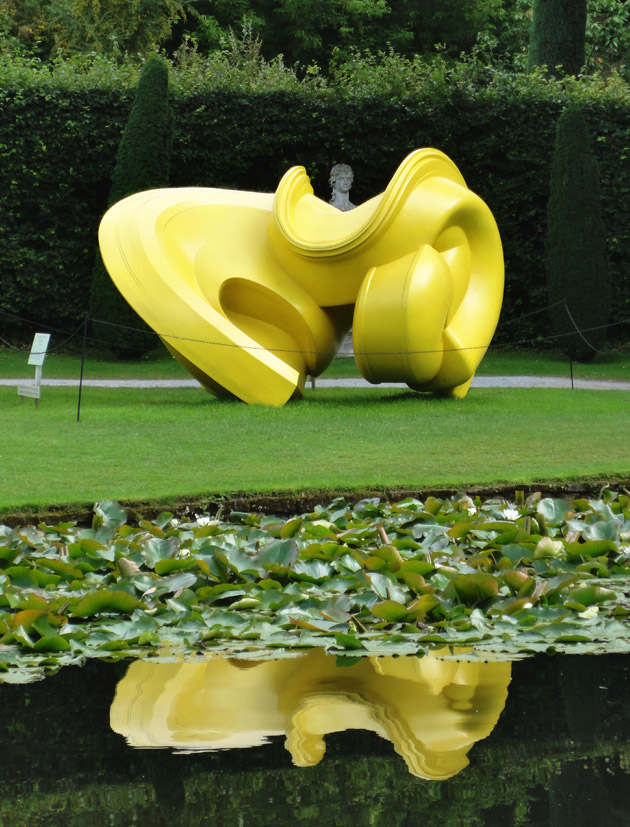
My first visit to Chatsworth a few weeks ago was inspiring from beginning to end. Aside from the spectacular House and visitor services that are second to none in comparison to many public institutions I have visited, I was fortunate to witness the rare spectacle of large-scale art installation that was taking place in preparation for Beyond Limits. Below are a series of photos I shot during my visit – from the precision installation of Alice Aycock’s gravity-defying Cyclone Twist to Marc Quinn’s gigantic bronze shell Spiral of the Galaxy through to the decorative details that may be discovered in the decadent interiors and the beautiful warren of gardens that are all unquestionably worthy of a revisit once full restoration is complete in 2015.

Beyond Limits opens today at Chatsworth and runs to 27th October 2013. Entry to the exhibition is part of a garden ticket - for further information visit Chatsworth and Sotheby’s for details on exhibiting artists and sales.
 Cyclone Twist, 2013 - Alice Aycock
Cornwall Slate Line, 2010 - Richard Long
 Spiral of the Galaxy, 2013 - Marc Quinn
Declination, 2005 - Tony Cragg
 Chaos Concepción, 2012 - Jedd Novatt

Marianna, 2013 - Jaume Plensa
Standing Woman, 2003 - Fernando Botero
 Pavilion, 1993 - Thomas Heatherwick
 Cavendish serpent
 
English Baroque style
Objects speak louder than words 
 Digital portrait of the Countess of Burlington, 2010 - Michael Craig-Martin
 Chapel - Saint Bartholomew, Exquisite Pain, 2006 - Damien Hirst 
 State Music Room
 Leicester Bedroom
 Room with a view
 Great Dining Room
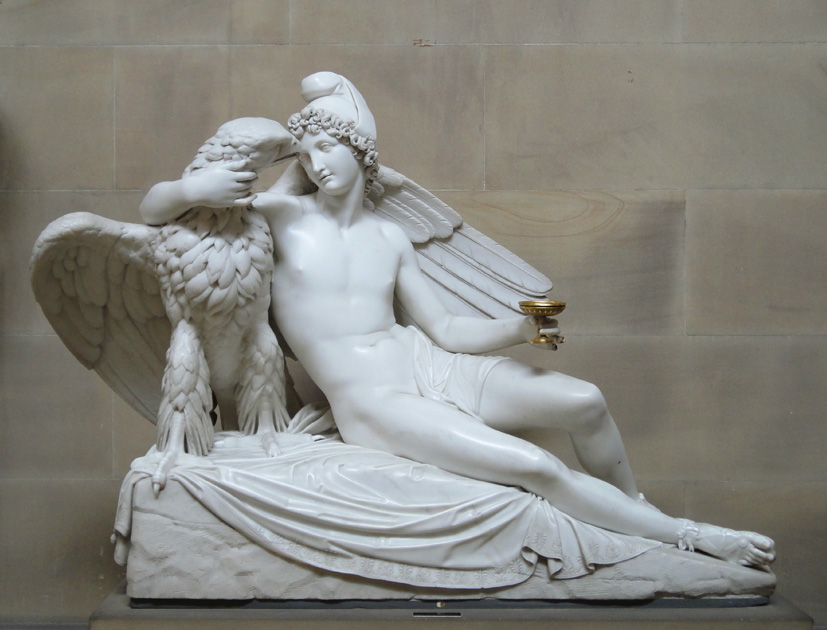
Sculpture Gallery 
 Marble lions (c.1823) by Francesco Benaglia (above) and Rinaldo Rinaldi (below) 
 Emperor Fountain
Picnic on the wild side
Officially launching later in the month by Sotheby's, Modern Makers will exhibit contemporary craft by international artisans in the main House. The exhibition will comprise of furniture, textiles, ceramic and metalwork, which will be on display throughout the famed English Baroque interiors of Chatsworth to create new dialogues between the past and present. Modern Makers opens on 18th September 2013 to 23rd December 2013.