6.7.12

The Grayson Perry Effect

Working Girl 
Credit to the gallery steward at Victoria Miro Gallery last weekend: pleasant greeting aside, the young, tall, skinny hipster at the front door was keeping an eye out for visitors who were treading precariously around the laboratory-esque installation that scaled the floors and walls by American artist Sarah Sze, as well as keeping his other eye out for members of the public that were, let’s say, not the gallery’s regulars. I somehow passed his beady-Bourdieu  gaze and was left to my own devices in the ground floor space. In contrast, the couple behind me was catered to a press release, clear directions to the Grayson Perry exhibit and put at ease with the balsa wood and table lamps confronting them: 'Grayson Perry is through the garden and up the stairs', was surprisingly what they wanted to hear, without even having to ask. As more visitors, babies, Bugaboos and Micro scooters came through the doors I watched admirably as he greeted the visitors, directing them through the garden and up the stairs. Had he been personally trained by Perry himself to pick out the suburban-explorer-on-safari-in-East-London from the usual gallery-goers on a Saturday morning? Taking lessons in social signifiers? Wearing your Sunday best on a Saturday is admittedly like having your railcard from destination-outside-the-M25 glued to your forehead and your A to Z of London hanging out of your bag, but this guy was good and clearly knew how to pick those who were there for the tapestries.
As someone who has been fascinated with ethnography and identity ever since my own days in the social stew that was art school (Associated Press, June 2010), I was finding this reactive environment around Perry’s exhibition equally attractive as what was to be through the garden and up the stairs. 
Squeezed Middle
The Vanity of Small Differences has been a two-prong execution that explores the taste tribes of twenty-first century Britain. A three-part series, All in the Best Possible Taste, was presented by the artist and complemented the opening of the exhibition on national network Channel 4 – following the everyday lives of the working, middle and upper classes, Perry portrayed the ultimate lifestyle detective; entering new-builds and manors alike, dissecting decoration of home and human. The series inspired six tapestries that depict the story of class mobility and reference the mid-eighteenth century paintings, A Rake’s Progress by William Hogarth, housed in London’s Soane Museum.
Living the highlife?
Channel 4 has a strong relationship with the contemporary art world. It is the official broadcaster of Tate and subsequently transmits highlights in the art world year such as the Turner Prize and more recently, a primetime exclusive of Damien Hirst’s first retrospective at Tate Modern transmitted into millions of living rooms across the nation (Money Maker, April 2012). With the network’s remit of minority interest during the Eighties, Channel 4 is now reaping its alternative agenda in an age of social acuteness that spans everything from art to artex. Spawn from the decade of Cool Britannia under Tony Blair’s New Labour, and importantly pre-recession, British aspiration soared and with growing confidence of expression came a greater divide of social superficiality. Cue Channel 4, who’s programming may arguably be seen as a taste barometer and resolutely aspirational: telling us where we should live in the UK (Location Location Location), or abroad (A Place in the Sun) telling us how to build our dream home (Grand Designs), how to fill it with things we’ve made ourselves (Kirstie's Homemade Home), how to entertain (Come Dine With Me), how not to enjoy it too much (Supersize vs Supeskinny) and telling us what to eat from the network’s messiah of metabolism Jamie Oliver. Perry therefore is in good company amongst the network’s middle class agenda and marks the culture box with a big (Nike) tick. If you followed the television series, you may have noticed that prior to All in the Best Possible Taste was Oliver’s soapbox prodigy Jimmy Doherty urging, in effect, working classes to buy ethically reared meat in Jimmy and the Giant Supermarket – if they stayed tuned they would then have Perry taunting them with middle class frivolity in Kent that comprised of yet more organic meat, John Lewis, AGAs, faux-William Morris, ethnic souvenirs, ‘green bling’ and crucially, homemade cupcakes - as if the working classes, or anyone else for that matter had enough to worry about than with keeping up appearances. The idea of homemade and DIY is an important element that binds Channel 4 with Perry – crowned as the crusader of craft after winning the Turner Prize in 2003, Perry possesses a greater element of public accessibility, than say with Hirst or Emin. The British tabloids may have introduced the YBAs to the nation but few can relate to sharks in formaldehyde and a dirty bed. While many may not be able to understand Perry’s cross-dressing alter ego Claire, ceramic vases and tapestries – objects that genetically exude skill – are familiar and culturally accessible to non-art audiences. Perry’s appearances on the BBC’s Question Time, Desert Island Discs and Have I Got News For You has opened his persona(s) to the masses and with the success of visitor numbers that attended his curatorial showcase, The Tomb of the Unknown Craftsmen at the British Museum last year, Perry is well on the way to one day reaching national treasure status. Dame Edna watch your back.
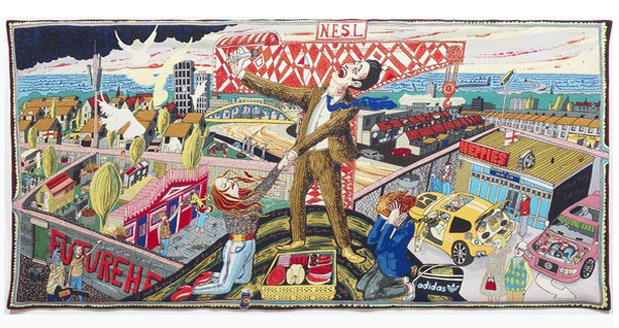
The Agony in the Car Park, 2012
The Annunciation of the Virgin Deal, 2012
The Upper Class at Bay, 2012
I am fascinated by this acceptance Perry has received and the influence he is now able to command, steering his cultural cohort from the familiar surroundings of the institution to one of the leading contemporary art galleries in the East End of London. I will not be explaining the works or the journey from Sunderland to the Cotswolds, via Royal Tunbridge Wells, that Perry takes on both screen and tapestry, but wish to share the live performance that was taking place before my eyes last weekend. A steady stream of visitors filled the light-filled gallery and admired the works of our very own twenty-first century Gobelins-guru. Young, old and even newborn set themselves on the journey from the innocently kitsch interiors of The Adoration of the Cage Fighters to the plush décor of The Annunciation of the Virgin Deal through to the two tragic landscapes of the upper classes – the only section of society that has nowhere to aspire to. Similar to my last visit to Victoria Miro in 2009 for Perry’s The Walthamstow Tapestry (A Question Of Craft Over Content?, November 2009) a wealth of allegory engulfs the large two-by-four metre wall hangings. Due to technological advancement, more texture and depth has been achieved with these latest works and the neon colours created by the weft are truly remarkable, resulting in an almost three-dimensional sensation. Saturday’s audience was captivated by such saturated seduction. The familiarity of brands and objects, which British sensibility inherently recognises in a default-class recognition manner; the very sensibility that I was seeing reflected between tapestry and viewer: the Cath Kidston bag, Birkenstocks, thick spectacles, iPhones and branded headphones to name but a few. “I have that… oh look, my tea towel… you used to have that...”, could be heard in the breaks of silence as couples and families associated themselves with the work and the characters from the television series. Like a mirror that reflects the past, present and future, visitors were entranced by the social taboo Perry presents in The Vanity of Small Differences. Yesteryear’s Burberry is this year’s Barbour, and so the brand bandwagon rolls on across all three classes - what Perry’s tapestries portray is a foundation of taste that is beyond instantaneous trend but of a culture that has evolved within one’s own walls and beyond, if such an environment so permits. The ornaments of social mobility are revealed to be a filler between life and death; in #Lamentation, these very ornaments – Ferrari, iPhone and other status symbol paraphernalia – come to their bitter end in the destruction that aspiration is capable of.  
Taste(less)? The general public let loose on the visitor book
I usually don’t pay any attention to visitor books but on my way out I couldn’t help but notice how well received it was and discovered a universal voice of the British public was being penned onto these pages that made for an extraordinary extension of the exhibition. Beginning with comments from the participants that featured in the television series to a mélange of society both near and far – professing, “We just came on a Middle class pilgrimage to London” - the visitor book was a font of personal reaction to the works, to Perry and life in Britain. Regional greetings were jotted, cultural conquests dropped – “… best thing I have seen since the last best which was Tomb of the Unknown Craftsmen!” – and personal taste revealed, “PS. There was a mother and toddler in a buggy. The kid was in buberry Jesus! What the fuck woman!?!”. 
One contribution read, “How odd that the subjects felt flattered”. Given Perry’s growing celebrity status and the lasting association with his work, it may not be so odd that the subjects from Sunderland, Royal Tunbridge Wells and the Cotswolds were genuinely flattered. Flattery however is an interesting concept – in 2009 when I reported on The Walthamstow Tapestry I noted that amidst the names stitched across the Bayeux-esque document, Perry’s name was absent. In 2012, the artist takes his position as social voyeur in the middle class depiction and can be seen in the reflection of the sun burst mirror, camera in hand, stitched within The Annunciation of the Virgin Deal. Playing on a style that has seen artists incorporate themselves into their paintings throughout art history, this is an interesting shift in Perry’s self perception since his accolades from 2003 and may be read as a nod to his acceptance in both greater society as well as the exclusive art world. The big players in the art world speak a language many do not understand au fait with sharks and bed sheets. In the first series of All in the Best Possible Taste Perry confesses he has, “…forged on to be comfortable in the art world” and I question whether he felt he was an ornament in the art world’s display cabinet – an exotica himself amongst the echelons of art society, curious of the craft that is now vying for space on the gallery floor. 
What is certain is that the general public’s taste for Perry and his taste for the general public is growing from cultural name drop to cross-cultural personality and television seems to be a medium the artist now relishes. Reports that Perry has signed a two-year deal with Channel 4 for a new commission around themes of etiquette and aesthetics means we will be seeing more of this 'tortured genius', whether he’s to our taste or not. If any network executives are reading this, I would like to propose my very own pitch, The Grayson Perry Effect, and follow the cultural pilgrims who are swapping their weekends in John Lewis for the white walls of the contemporary art gallery: a How To Look Good (at an art opening) meets Coach Trip perhaps? Stay tuned…
       
Visit Victoria Miro for further details on The Vanity of Small Differences and catch up on 4oD to view In the Best Possible Taste series from each social class who inspired Perry along the way.

The Vanity of Small Differences
7th June - 11th August 2012
Victoria Miro Gallery
16 Wharf Road
London N1 7RW

4.7.12

Happy 4th Of July!

... tread independently hispsters

Happy Independence Day to all my American readers 
across the pond and beyond!

21.6.12

Dream On

Time Magazine's forthcoming U.S. edition explores the work-hard-play-hard ethos of a nation that has hit the top of the aspiration charts, but is it all singing and dancing in the world of politics, pop culture and picket fences? The Making of America Issue: The History of the American Dream hits newsstands this Friday. 

20.6.12

Out Of The Shadows

After its official presentation at Museum der Kulturen during Art Basel last week, Hiroshi Sugimoto's latest collaboration with the French luxury house of Hermès is now available in stores and the design and production process of the twenty-strong silk scarf collection by the Japanese photographer can be viewed online at its dedicated Hermès Editeur homepage. As I previously reported earlier in the year (Silk Snaps, March 2012) the limited edition ink-jet prints measuring fifty-five inches square have been inspired by Sugimoto's Color of Shadow (Couleurs de l'Ombre) series - based on luminous Polaroid colour gradations, this makes for yet another exciting addition to the luxury house's expanding artistic portfolio after Josef Albers and Daniel Buren whose collaborations may also be viewed online.
Below is an insight to the collaboration from drawing board to production line of the exclusive one hundred and forty art cum fashion works: each scarf colourway consists of an edition of seven, individually numbered by hand by the artist and priced at $7000.00 - an investment at a snap for both collector and connoisseur alike.  
Hiroshi Sugimoto at Hermès
Couleurs de l'Ombre will tour after Art Basel and is due to land in Brussels at La Verrière in September with further cities scheduled before the end of the year - for more details visit Hermès Editeur.
Images courtesy of Hermès

16.6.12

Recounting Palestine’s Stories

Left to right: Armour (Boy) & Armour (Family), 2012 at Artspace Dubai London
It was an evening where the adage, a picture is worth a thousand words, was no more convincing than in SW3 last Thursday at the opening reception of Recounting Palestine’s Stories: An Intervention by London-based charity Al Madad Foundation. Here’s an update from my previous post (Show & Tell, June 2012) which documents my own works Armour (Boy) and Armour (Family) installed at Artspace Dubai’s London outpost in the heart of Chelsea as well as contributions from the six artists who all approached the monchrome photographs in their own unique style and medium. 

Drawings by children in rehabilitation, Bethlehem
It was a pleasure to meet all the artists and be able to share our own stories behind the works that make up this diverse and narrative-rich exhibition, such as the intricate brushwork by Gemma Nelson and the equally imaginative drawings from children in Bethlehem that share the space. Thank you to everyone who made it out on Thursday – the evening was a huge success with all proceeds from the sale of the artworks being donated to Ghirass Cultural Center, Bethlehem for the continuation of valuable art and cultural activities and a dedicated education programme that helps hundreds of children from local communities in the area. 

Recounting Palestine’s Stories: An Intervention is open daily and runs to 23rd June 2012 – visit Al Madad Foundation for further information on their mission across the world and contact aya@almadadfoundation.org for details on the exhibition, artists and works on display. 
 Marie Sennyey - Fables, 2012
  Marie Sennyey - Middle Middle, 2012
  Zoe Sua Kay - The Girls Hit the Town, 2012
   Namir Alireza - Paradise Awaiting, 2012
    Namir Alireza - The Girl and The Wall, 2012
    Gemma Nelson - Palimpsest of Twilight, 2012
    Xuan Minh Hoang - Games We Play, 2012
   Bianca Brandhuber - Quilted, 2012

Recounting Palestine’s Stories: An Intervention
15th - 23rd June 2012
Artspace London
7 Milner Street
London
SW3 2QA
Nearest tube stations: Sloane Square & South Kensington 

11.6.12

Show & Tell

At the beginning of the year I was approached by London-based charity Al Madad Foundation with an invitation to participate in an exhibition that would benefit its established rehabilitation programme through arts and education that support children in fractured communities and vulnerable situations across the UAE, Jordan, Lebanon and Palestine. Under the direction of good friend and fellow Slade Alumni, Aya Haidar, Al Madad Foundation continues to expand its message of artistic expression and inter-cultural dialogue in order to address the continuing problems that plight children in turbulent areas of the Middle East.
It therefore gives me great pleasure to release details of the exhibition, Recounting Palestine’s Stories: An Intervention that will open this week in London as well as a few images of the prints I have been working on in my studio since February. A series of twelve monochrome photographs previously taken around Occupied Palestinian Territories have been reworked and recontextualized to create unique prints that are rich in narrative and bridge both geographical and political distance with unified conceptual expression. I will be exhibiting with six emerging artists from the United Kingdom, each of whom will contribute their personal interpretation and medium to their prints, alongside a selection of drawings produced by Palestinian children from Bethlehem – Haidar explains, “The exhibition is not politically motivated, but rather is a platform for empowering the otherwise voiceless child through the universal language of visual art.”
 

I was particularly interested in this idea of voicelessness. There is something magical about a child devising a story where imagination has no limits however amongst the familiar fruit trees and sunbeams found in these drawings were military aircraft flying in the sky and soldiers with firearms on the ground. I certainly remember drawing the impossible as a child – the children of Palestine are no different yet the unimaginable to many is a reality that is simply depicted in crayon. One can easily forget that innocence can also be terrifying – I wanted to help carry this imagination beyond the school walls in Palestine and extend the journey of these stories with my two works, Armour (Boy) and Armour (Family).

Exploring the notions of the subconscious and one’s own inherent emotion of protection, I based my two works around a world that undervalues loss. I personally know how the power of loss can be so debilitating, least of all when such an emotion strikes a child. Through the eyes of the children of Palestine loss is a balancing act played out in the everyday, tenuously held together by joy and fear, love and hate, life and death. I believe strength is a product of loss – armour that cannot be seen or felt beyond a smile as much as a teardrop. 
Armour (Boy), 2012
Intervention on photographic print
Nickel-plated, brass studs
1060x1550mm
By referencing the earliest need for protection and armour in the late-thirteenth century to youth culture and ‘Liberty’ spikes that symbolised the anti-materialist social movement of Punk in the late-twentieth century, I was able to introduce parallels between the loaded symbolism attributed to an object and the continual redefinition of one’s own identity and ultimately visibility during times of social divide, past and present.
The notion of armour as identity that is presented in my works expose the silent power of youth that is a far cry from the objects in which they are portrayed in conflict. In the same way I have reworked the surface to expose new narratives, the metal decoration of hundreds of brass studs embedded into the photographic landscape exposes this very invisibility of a child’s inherent armour and evolving subconscious that can never be taken away and that can never be lost - a personal construct of emotion and understanding, deserving of a child that has witnessed and acknowledged destruction: armour fit for a lifetime.
Armour (Family), 2012
Intervention on photographic print
Brass-plated, brass studs
1060x1550mm
I am very excited to be a part Al Madad Foundation’s first project with International artists in London - all proceeds from the sale of artworks will be donated to Ghirass Cultural Center, Bethlehem. For further information about the exhibition, the Middle East’s urban guide Brownbook previews the show here and look out for a report in leading pan-Arab newspaper Al-Hayat later this week.

Recounting Palestine’s Stories: An Intervention opens this Friday 15th June and runs to 23rd June 2012 at Artspace Dubai's new London outpost in Chelsea. On Saturday 16th June contemporary performance act ice&fire will present Palestine Monolgues at the space – for reservations contact aya@almadadfoundation.com

Follow @JMVELARDI for the latest news after its opening later this week and throughout the exhibition period and visit almadadfoundation.org to learn more about this worthy charity and it's projects for the future of children in the West Bank and beyond. 

Recounting Palestine’s Stories: An Intervention
Artspace London
7 Milner Street
London
SW3 2QA
Nearest tube stations: Sloane Square & South Kensington 

7.6.12

Brooklyn Migration


Flamingo Parade, 2010 supported by Lower Manhattan Cultural Council
Amidst last weekend’s Jubilee celebrations here in Great Britain, I was ecstatic to receive news from across the pond on Saturday morning from good friend and Space All Over-curator Anna Lise Jensen that my public art intervention Flamingo Parade has found a home at Red Shed Garden in the community of Greenpoint in Brooklyn, New York City which hosts a Community Support Agriculture organic food distribution programme as well as a platform for education on nutrition for schools within the community.
For regulars to this blog, many will know this has been a long time coming – conceived when I was living in Manhattan in early 2009 when I was given the opportunity to participate in the artist-community initiative A Lot of Possibilities, that has seen a group of international artists working towards integrating contemporary art around the Upper West Side and Manhattan Valley, Flamingo Parade was directly inspired by the Community Garden at West 104th Street, whose charming green character I looked down on from my apartment window.
With the support of the Lower Manhattan Cultural Council in 2010, Flamingo Parade was realized into a 31 x 9ft vinyl banner in order for the original illustration, that had been created in situ a year before, to be installed into the urban landscape within the rare, yet determined, green spaces of New York City. 
I must say a big thank you to both Anna Lise and everyone at Red Green Shed for their enthusiasm for my work and for helping to install it last week - those of you who are stateside can now see Flamingo Parade in the garden from Skillman and Kingsland Avenues – nearest subway Graham Avenue on the L line. 


Red Shed Garden
264 Skillman Avenue
Brooklyn, New York
11211

More images and updates are due to follow in the run up to the installation’s official launch and community gardeners’ event in late June - from the very latest from New York follow @JMVELARDI
You can also follow Flamingo Parade’s journey with an archive of news and images from my time in New York, the Upper West Side community garden to the streets of New Jersey, Bushwick and Williamsburg, across Massachusetts and the work's migration to Greenpoint, Brooklyn over the last two and half years. 

Find out more about the early stages of A Lot of Possibilities by Anna Lise at spaceallover.org to see all the contributing artists and projects around the Community Garden at West 104th Street.

28.5.12

Diamond Jubilee X Studio Velardi

The countdown to The Queen's Diamond Jubilee has officially begun across the United Kingdom and the Commonwealth and it's no different here in Windsor at Studio Velardi. In what is the same year I conceived the creative design enterprise, Studio Velardi marks Queen Elizabeth II's sixty year reign in 2012 with a new red, white and blue Twitter background and witty homepage design that goes live from today and for the duration of the Jubilee celebrations. 

This weekend Studio Velardi will be at a special Jubilee Windsor Emporium with my exclusive collection of environmentally friendly stationery on Sunday 3rd June at The Guildhall, Windsor - visit Windsor Emporium for more details and follow twitter.com/studiovelardi for the latest news on my whereabouts around Windsor and Berkshire. 


Connect the dots with the new homepage design at studiovelardi.com


All rights reserved © studiovelardi 2012