The world’s Press have descended on London again to
pitch up on very different turf from the sporting spectacle of twelve months
ago. In a corner of West London, St Mary’s Hospital in Paddington has been home
to international royal correspondents, news anchors and television crews for weeks, all eagerly awaiting the birth of Their Royal Highnesses The Duke and Duchess of Cambridge’s first
child. Now days after media speculation the due date would be Saturday 13th July, newsrooms have surrendered to the waiting game, covering royal baby stories
of both the absurd and sublime variety.
From commemorative coins, chocolates
and even cheese to a twenty-first century must-have: an app - affirming baby Cambridge as the most
anticipated birth since the beginning of Twitter. The Royal Baby app,
which intends to document various ‘firsts’ by the new addition to the House of Windsor in the coming
months for dedicated royal followers who simply cannot wait for ‘commemorative’ publications to hit newsstands day-after-week-after-month. I myself could not resist
getting involved in The Great Kate Wait and I had CNN’s Royal Correspondent Max Foster question Mario Testino whether he would be shooting the first official
photograph of the royal trio, after spotting him at a charity function at Prince Charles's London residence,
Clarence House last week - could Testino be keeping silencioso?
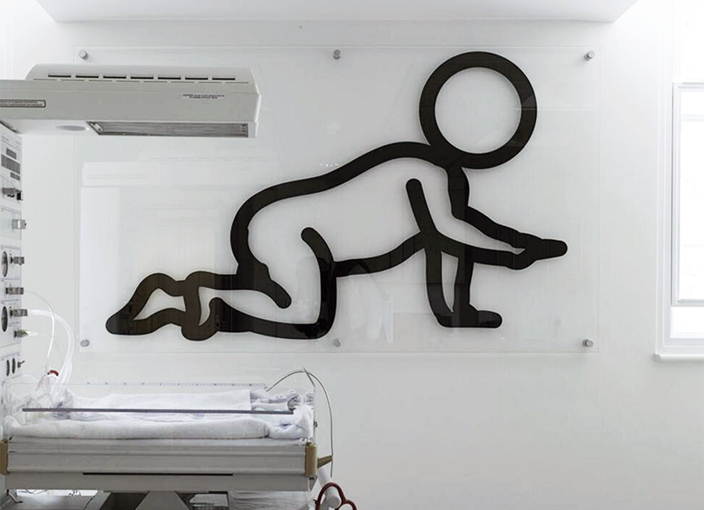
While the media scrum have created somewhat of an art installation in their own right out of stepladders and duct tape in a kaleidoscope of colours on the sidewalk opposite the hospital, within its very walls one will discover that even the art world is included in the royal baby furore. The sterilised operating spaces of a hospital are after all akin to the clean, white walls of a white cube and in the private maternity unit of the Lindo Wing - specialising in labour, delivery and postnatal care and where Princess Diana gave birth to Princes William and Harry in 1982 and 1984 respectively - the worlds of medicine and contemporary art come together in a unique installation created by British artist, Julian Opie.
During its eighteenth-month renovation St Mary’s Hospital commissioned Opie to create forty panels of his trademark graphic portraits rendered with minimal detail, using thick, black lines for both the interior and exterior of the Lindo Wing, where the Duchess of Cambridge is due to give birth to the third in line to the throne.
The permanent installation includes works of various sizes depicting tall, elegant women and crawling infants on transparent surfaces, light boxes and glass set against a neutral palette that feature along the walls of the wards, delivery rooms and building's façade.
In an interview with The Telegraph, the artist talks of his intention to “enliven”
patients with art that has a function to excite and the works certainly provide a special and alternative
visual stimulus that is so very different from generic colour-conscious interior design, common on the bureaucratic agendas of public institutions. Given the Duchess is Patron of the capital's National Portrait Gallery she will appreciate the art around the unit and
there is no doubt Opie will be amused that his work will be the first art seen
by the future King or Queen of England. It would be wonderful if Their Royal
Highnesses commissioned Opie to produce their newborn’s first official portrait
in his contemporary style and save face amongst the art world with the rather disappointing choice of painter selected for the Duchess’s first official portrait unveiled
earlier this year (A Portrait Of A Duchess, January 2013).
Paul, baby - 2001
My
very best wishes to Their Royal Highnesses on
their special delivery and as it so has been welcomed into this world, may their child be raised to reign supportive of arts, culture and creativity.
Visit Imperial College Healthcare NHS Trust for more information about the renovation to the Lindo Wing at St Mary’s Hospital. Images courtesy of Julian Opie
For its latest exhibition the Royal Collection explores
the sumptuous costume of British monarchs and their court during the sixteenth
and seventeenth centuries. The Queen’s Gallery at Buckingham Palace has
previously hosted celebrated exhibits such as Leonardo da Vinci: Anatomist and Renaissance
works from Northern Europe – all of which are in no short supply in what is one
of the finest, and oldest, comprehensive art collections in the world.
Henry VIII, c. 1530-35 - Joos van Cleve
With over sixty paintings, drawings, garments, armour, jewellery and accessories on display, In Fine Style: The Art of Tudor and Stuart Fashion documents the evolving avant-garde tastes of both royalty and the elite in England and across the Continent.
Speaking with me at a Bloggers’ Breakfast preview, the exhibition’s curator, Anna Reynolds explained the Royal Collection’s new agenda for The Queen’s Gallery as a cultural destination for all interests – akin to its London counterparts such as the Victoria & Albert Museum and Somerset House. Given the collection’s vastness of in-house content and context, traditional and academic themes have tended to be favoured over more popular avenues such as fashion, which incorrectly assumes superfluous and solely superficial status in comparison. What has been the culmination of three years of research In Fine Style is by no means art-lite. The exhibition is a first for the Royal Collection on several counts: it is the first time it has looked at fashion in portraiture; the first time objects have been loaned to the collection, breaking with longstanding curatorial mandate, and the very first time a playlist has been commissioned to accompany the exhibit. Anna proudly describes the collaborative, and eclectic, direction she has successfully achieved – working with The Blackborne Lace Collection at The Bowes Museum to XFM DJ and musician Eddy Temple-Morris and international fashion designer Gareth Pugh – to create a multi-sensory experience of fashion as spectacle as well as its depiction through art, bridging the historic with the contemporary.
As the first monarch to embrace fashion in court, Henry VIII welcomes visitors into the space by way of his potent portrait by Joos van Cleeve. Power was woven into the construct of fashion and there is no better royal than the second monarch from the Tudor dynasty to set the tone of the exhibition in all its rich, allegorical splendour. The meeting between Henry VIII and Francis I of France in 1520 in Balinghem, near Calais, was a dazzling installation by both royal courts to outshine one another using unimaginable quantities of elaborate gold cloth - woven with silk and gold thread - for costumes and the erection of temporary palaces. The monarchs had enforced so much attention to flamboyancy and presentation that the meeting place took the name,Field of the Cloth of Gold, due to is impressive execution and scale, to which this portrait is suggested to commemorate.
Young Royals power dressing:
Princess Elizabeth I & Prince Edward VI - attributed to William Scrots
This is a fine example of the roles fashion and taste played in communicating wealth and status – important aspects of Tudor life that can be traced down to Princess Elizabeth I and Prince Edward VI, painted by William Scrots, who flank their Father and join members of the Tudor court illustrated by Hans Holbein the Younger. Entry to the royal inner circle, which directly granted political and professional upward mobility, had been largely driven by personal appearance and the cut, cloth, colour and composition of garments and accessories became sartorial symbols of success for both sexes.
William Parr, c.1538-42 - Hans Holbein the Younger
Majestic monochrome: Henry Stewart & Charles Stewart, 1563 - Hans Esworth
In the knowledge that the exhibition has fashion in its title, it certainly triggers one’s attention to the cuffs, ruffs, pattern, pleating, jewels, hats and hairstyles that command equal weight with the historical significance of the canvas within this specific context like never before. In Fine Style questions the extent of the artists’ execution of representing fashion as the genuine article or an interpretation for canvas as not to detract from the subject. This idea of painting as a reliable source is raised in works by Sir Peter Lely who controlled his aesthetic by adapting the sitters’ attire. One of the exhibition’s highlights is a lace cloak band, or collar, reputed to have belonged to Charles I on loan from The Blackborne Lace Collection. The finely embroidered needle lace of linen thread is an exquisite example of technique as well as preservation of its rarity. Its allure is greatly magnified as it stands aside Sir Anthony van Dyck’s enduring triple portrait of the monarch, with only the glass display case separating its contents from canvas with an almost identical representation in form and design of the cloak band, depicted to be worn by the monarch in his profile to the right.
Charles I, before June 1636 - Sir Anthony van Dyck
A pair of late-seventeenth century embroidered velvet mules are looked on by their owner Henrietta Maria, wife of Charles I, in a nearby painting also by van Dyck. The dainty heeled shoes that were invented in France to project one’s social standing find themselves in an installation of extremes between the feminine and androgynous as can be seen in the portraits of cover girl for the exhibition, Frances Stuart, in dress and soldier costume – painted by Lely and Jacob Huysmans respectively. Simon Verelst’s portrait of Mary of Modena in a masculine-inspired riding habit also plays with notions of androgyny, the practicality of feminine attire and in this instance, a symbol of her marriage to the Duke of York who wore a similar coat design at their wedding in 1673.
Mary of Modena, c1675 - Simon Verelst
The low hanging installation of paintings is a triumph of intimacy between viewer and canvas. Fashion enthusiasts will no doubt be in their element when confronted with the intricate patterns of stitching or formation of pearls in oil paint and the minute brush strokes that form the illusion of crisp white ruffs that alone would have cost the equivalent of between £10,000 and £20,000 in today’s money.
The detail however can admittedly be overwhelming – even after five centuries, this is a testament to precisely what the royal court intended to achieve in its day. In addition to a video interview (above) with fashion designer Gareth Pugh who points to Elizabeth I as inspiration for many of his collections in his East London studio, the free multimedia guide also provides an excellent escape from up-close examination with a twelve-track playlist curated by XFM DJ Eddie Temple-Morris.
In response to a selection of paintings that are featured in the exhibition, music by contemporary artists have been chosen to complement the works of art and introduce a unique visitor experience walking within the gilded setting that is The Queen’s Gallery.
Charles II, 1644 - William Dobson
Some song titles easily link track to image – William Dobson’s painting of Charles II in armour is paired with Reso’s War Machine and van Dyck’s triple portrait of Charles I with Angles by dan le sac Vs Scroobius Pip. More abstract selections come in the form of Lana del Ray’s Blue Jeans hit remixed by Maribou State that reflects the ethereal score with the ethereal beauty of Frances Stuart.
Frances Stuart, before 1662 - Sir Peter Lely
I particularly enjoyed Temple-Morris's choice of Dubstep in Nero's Innocence selected for the magnificent portrait of Charles I’s three eldest children by van Dyck. In 1635 the young Prince Charles had come of age and therefore wears a golden doublet and breeches to display his loss of innocence, in contrast to the tradition of young boys, as depicted by his younger brother (centre) who wears a skirt. The 2010 release crescendos to a sense of foreboding that not only echoes the young Prince’s imminent future as King, but the state of the country during the English Civil War and subsequent execution of these children’s Father in 1649.
The Three Eldest children of Charles I, 1635-36 - Sir Anthony van Dyck
Armour’s design and styling on the battlefield directly copied fashionable tastes of the time, often with detail found on expensive fabric being replicated in metal through engraving and with additions to produce a highly decorative surface in silver and gilt. An extraordinary display links a miniature of Henry, Prince of Wales by Nicholas Hilliard at the age of thirteen wearing a suit of armour dating from early-seventeenth century France.
Henry Prince of Wales, 1607 - Nicholas Hilliard
The same armour, or Cuirassier, that Hilliard illustrates can be found adjacent in all its intricate beauty and attention to detail that strikes an image of pure physical strength of the young prince.
Cuirassier armour, c. 1607 - French
In the final room of the exhibition, Continental tastes are explored as closer relationships are formed between the European courts. On the Continent, fashionable styles were closely linked to political power – Spain’s strong influence coincided with its political dominance across much of Europe in the sixteenth century that was later to be succeeded by France’s supremacy in both politics and fashion under the rule of Louis XIV from the court of Versailles. The English were viewed as chameleons, adopting different elements of costume from Europe as a result of greater circulation of prints and portraiture. It was not until Charles II's reign that a notion of Englishness, portrayed directly through fashion, developed in the eyes of Europe: introducing the precursor of the men’s three-piece suit and abandoning a short doublet and cloak for a long vest and coat – a trend the diarist Samuel Pepys could not resist to replicate. On display are portraits that demonstrate the links and distinctions across Europe that include mirror images of Prince Rudolf and his brother, Archduke Ernest of Austria wearing replica fashions painted by Spanish court artist, Alonso Sánchez Coello and the subtly divine costume of Agatha Bas by Rembrandt van Rijn.
Rudolf II, Emperor of Austria, 1567 - Alonso Sánchez Coello
Agatha Bas, 1641 - Rembrandt van Rijn
Fashion is one of very few facets in history that is
able to communicate without words by means of a visual and tactile language. When
discussing royal fashion, it is impossible not to mention the phenomena of
style that has accumulated throughout the centuries to the present House of
Windsor who receive fanatical dissection from head to toe. While technology may
have opened up the once-exclusive royal wardrobe of material and styles, personal
expression through fashion is just as powerful today as it was in Tudor England.
From Victorian romanticism to a dapper Duke of Windsor; a colour-conscious
Queen Elizabeth II followed by a furlong of hats and fascinators in her reign,
to the most recent obsession with the fashionably accessible Duchess of
Cambridge. In Fine Style presents an impressive formula for future curation: in an age when modern monarchy is seen and not heard, it will be
their costumes that historians will look to for invaluable messages of
evolving identity to expose the social and cultural influences of epochs past,
present and future.
In Fine Style: The Art of Tudor and Stuart Fashion is on exhibit at The Queen’s Gallery, Buckingham Palace until 6th October 2013. For further details about events, educational programmes and ticket information visit the Royal Collection's official website.
In conjunction with the exhibition, an interactive
app has been inspired by a curious portrait miniature of Henrietta Maria that
includes hand-painted overlays where she may be dressed in a variety of male
and female costume. The free app allows enthusiasts to dress the rich and the
powerful from the sixteenth and seventeenth centuries as well as take
self-photos and transform into fashionable royalty of the day - available to
download from iTunes.
The walls of Kensington Palace may have a wealth of
stories to tell of its royal occupants since the seventeenth century; William
III, the young Queen Victoria and Princess Margaret, however it is
unquestionably recognized for its symbolic role adopted by the public as a
place of tribute after the tragic death of Diana, The Princess of Wales in 1997.
The sea of flowers and sentiments outside the late Princess’s home are some of
the most iconic images of the twentieth century and has since shaped public
behaviour towards celebrity and Monarchy alike.
Tomorrow the doors of Kensington Palace will reopen after a year-long twelve million pound restoration project in time for the Queen’s Diamond Jubilee and Olympic Games, launching with the exhibition, Diana: Glimpses Of A Modern Princess. Installed in Apartment 1A where the late Princess resided, and scheduled to be the future home of The Duke and Duchess of Cambridge next year, the exhibition will reflect some of the most important and memorable moments in Diana’s public life and will focus on her iconic fashion and style. If the Grace Kelly: Image Of A Movie Star at the Victoria and Albert Museum, London or The Metropolitan Museum of Art’s Alexander McQueen: Savage Beauty is anything to go by, fashion sells both on the streets as well as in the galleries and will undoubtedly be a sell out show forHistorical Royal Palaces who run the royal residence in West London.
Dresses aside, the curators of the exhibition were intent to avoid a formal institutional display, perhaps conscious of the creative expectations that such showstoppers now command, and have commissioned contemporary illustratorJulie Verhoevento produce a modern toile based on moments throughout the Princess’s life, incorporated into a wallpaper repeat pattern in a graphic collage in watercolour.
Diana with newborn Prince William
Drawing from photographs of Diana’s engagement announcement to Prince Charles, subsequent wedding, royal tours around the world and the last portraits to be shot by Mario Testino as well as architectural elements that resemble that of the palace or from Althorp, the resting place of the Princess at her ancestral home, Verhoeven employs her trademark technique to introduce a contemporary atmosphere within a loaded historical setting of both pomp and pop culture. While if a little naïve and childlike given the context of a woman in her prime, the style is resolutely Nineties, similar to the bright kitsch children’s wallpaper that I remember from the decade that was to be Diana’s last.
Diana shot by Mario Testino
Printed by hand in England by interiors firm and royal warrant holders
Cole and Son who produce traditional period designs, the wallpaper will be
installed throughout the exhibition in the palace’s State Rooms and will
reflect the lasting influence in style and history of the Mother of the future
King of England: whether this is the grande finale of a commercial chapter past
in order to allow for chapters anew to evolve in the highs and lows of the
dynasty of the Windsors is still to be seen. For now, memories of the past fuel
what is a record period of public popularity and a right royal renaissance in
the year where the matriarch of the British Monarchy celebrates sixty years on the
throne.
I am very fortunate to call Windsor my home – twenty
one miles from central London, the historic town in Royal Berkshire is famed by
its castle and its royal residents throughout the centuries, of which the
current Royal House adopted its namesake during a First World War rebrand –
unsurprisingly Saxe-Coburg-Gotha didn't quite have the right ring to it. The town is pseudo-country; formed around the private and public
crown estate of Windsor Great Park, one can instantly be lost in an ocean of
forest or fields when exploring off the tourist ant-trail, only to discover
there is much more history beyond the castle walls. Down the Long Walk - arguably
the most impressive approach to a residence in the Land - and beyond the Copper
Horse, lays a community of duty and heritage. While accessible only by foot or
by bicycle to the public, The Great Park is my home turf and my runs around
this five thousand acre estate over the years have still not taken me to its
every corner. A few weekends ago I stepped back in time – the twelfth century
to be precise – to visit the exhibition A Pageant of Heraldry organised by The
College of Arms and Cumberland Lodge.
Cumberland Lodge is a residence within The
Great Park dating from the middle of the seventeenth century. Since its
formation as a charitable foundation in 1947, it provides an
informal centre for academic exchange – it’s panelled rooms proved one of the
most interesting exhibiting pop-up spaces I had been to for a while.
During
my time with the Royal Collection at Windsor Castle a few years ago, I could
not resist growing a fascination with heraldry. Besides the fact that there is
symbolism carved onto every chair, table, pane of glass and slab of stone
around the castle apartments, as an artist the visual language that these
symbols created were truly mystifying and formed one of the first concepts of a brand through visual recognition in history. Whether it is the sea of shields across
the ceiling of St George’s Hall or the sacred decoration that is at the heart
of the foundations of St George’s Chapel, it is easy to be enchanted by the genealogical
history of characters past and present.
Heraldry derives from the word Herald
and was first mentioned in Western Europe about the time of the First Crusade
(c. 1100). Acting as messengers, diplomats and army staff officers, Heralds
were attached to household rulers and magnates around the country where they
used their expertise in identifying army commanders by their coat armour -
markings painted on their banners and shields – since helmets denied facial
recognition during war. This was a valued skill and precise identification in
battle was paramount. Their experience led to taking responsibility of ceremonial
duties at court and they were acknowledged as members of the Royal Household
under Henry V in 1415 as ‘King of Arms’.
Their device of indexes, rules and
terminology around the insignia of arms form the basis of heraldic law and
language that continues to provide a service today by the office of the
Earl Marshal – itself a hereditary position through the Dukes of Norfolk since
1672 - who represent the Sovereign in the authorisation of all arms and grants.
The exhibition illustrates the importance of heraldry as a mark of
identification and charts the importance of heraldic seals as a means of
authenticating documents in the late Middle Ages to the interest of institutions
and public bodies from the beginning of the eighteenth century of which
interest maintains in contemporary society and continues to be presented with
an ornate Grant of Arms document approved with a Great Seal.
Tabard of King of Arms, bearing the Royal Arms on velvet
Tabard of Pursuivant of Arms, bearing the Royal Arms on silk
Highlights from
the exhibit include tabards of King of Arms and Pursuivants of Arms beautifully
embroidered on velvet and silk respectively, as well as The late Queen
Mother’s personal banner which is uniquely on display.
While it is assumed
that coats of arms are only reserved for royalty and nobility, with the
emergence of a celebrity class towards the end of the last century within
Britain’s inherent class system, a slice of noble decoration can in fact be
purchased by anyone, at a price. With the trend ignited by rock royalty such as
Sir Elton John and Sir Paul McCartney, celebrity culture in Britain aspired for
heraldic heritage – this was notably documented in the press when David Beckham
and then-to-be wife, Victoria Adams commissioned a coat of arms inspired by the
British Premier League Football trophy in 1999. Reports came out that the
couple wished for the swan - that is incorporated in the design - to face a
specific direction and that it had been suggested the swan should face the opposite
direction since the great heraldic lexicon dictated the original direction
would have implied the male bearer’s sexual preference to men. Most recently
however, the coat of arms of a certain Kate Middleton received global attention
on the announcement of her engagement to Prince William. Royal protocol
requires both parties of the royal couple to provide arms – the Middleton
family commissioned a coat of arms with the help of Garter Principal King of
Arms, Thomas Woodcock, resulting in a personal design
that symbolised the family’s association with West Berkshire and their interest
in outdoor pursuits, while representing all five members of the Middleton
family through colour and composition.
Printed onto the official souvenir
programme on the day of the Royal Wedding earlier this year (Something Old Something New, April 2011) it is undoubtedly the most recognisable coat of arms in 2011, if not this
century. However once Kate Middleton officially married into the Royal family
to assume her title of Catherine, Duchess of Cambridge, her coat of arms
instantly ‘combined’ with that of Prince William. Where protocol necessitates
this new design will be used to represent the Duchess and also gives the
opportunity to watering holes around the country to fashion themselves after
the newly appointed royal – the first pub in the country to be named after the
Duchess was in fact registered in Windsor where the coat of arms can be seen
above the entrance.
The importance of heritage in
contemporary society is no more evident than in the new advertising campaign
that was launched by British Airways in late September. While companies invest
millions into rebranding their product with a new direction, the airline looked
to their past and reintroduced a brand element from their 'Landor' livery that was used between 1984-1997. Perhaps a clever marketing strategy on the eve of the
British Monarch’s Golden Jubilee as well as the hosting nation of the Olympic
Games next year, the airline has chosen to reintroduce a newly stylised version
of their coat of arms and motto, To Fly. To Serve - granted to them by the
College of Arms in 1975 - on their aircraft, uniforms and all other aspects of
brand BA. Profiting from the ‘made in Britain’ trend that is proving to be a
currency worth investing in across all market sectors, the expression of
genuine heritage is an element of branding money cannot buy. The majestic
nature of a coat of arms supersedes any fancy, modernist design, embodying a
sense of seniority, quality and even timelessness that will no doubt charm
customers aboard the nation’s flag carrier.
A series of crests - including a chrysanthemum of the Emperor of Japan (centre)
While contemporary events of
public interest shine the media spotlight onto the heritage of the
College of Arms today, it is the annual event of the Most Noble Order of the
Garter within the walls of Windsor Castle at St George’s Chapel - heraldry’s
spiritual home since the Order’s foundation in 1348 by Edward III – that
emphasises the historical importance and splendour of a service that is so intrinsic
in this country’s very own brand identity that will last for another eight
hundred years.
A Pageant of Heraldry may still be viewed at Cumberland
Lodge on Wednesday 26thNovember – click here for visitor information.
For further details on heraldic history and lineage, enquiries may be made to
the Officer in Waiting at the Collage of Arms, which is open on weekdays
throughout the year. Access to St George’s Hall and St George’s Chapel at
Windsor Castle is open daily – the wardens are well versed in the castle’s
history and are more than happy to help with any questions – ticket information
can be obtained at The Royal Collection.
The College of Arms Queen Victoria Street London EC4
. Cumberland Lodge The Great Park Windsor, Berkshire SL4 2HP
Writer and contemporary visual artist working between Los Angeles and London.
Available for articles and reviews on contemporary art, design, fashion, lifestyle, travel, profile and events – no subject is out of bounds and challenging briefs are very welcome - view a selection of my published work at jonathanvelardi.com
jonathanvelardi.blogspot will report on art, culture and lifestyle from the #highlife to the #lowlife across the www and beyond...